
Basic
Elements

What is Mystrikism?
🎧 Audio Version 🎧
Mystrikism is a sensible, syncretic, inferential, and principled philosophical discipline that offers a rational, provisionally naturalistic and physicalist alternative to traditional religion. We seek to provide a logical ethos that values critical thought, disciplined inquiry, and ethical action informed by the real consequences for veracity, well-being, suffering, justice, and ecological flourishing. We do so without relying on unsubstantiated ingredients such as the supernatural.
Syncretic refers to the blending of ideas, beliefs, and practices from diverse sources into a cohesive whole. Mystrikism aims to draw the best from all worlds, incorporating any viable, inferential, and useful insights. Inferential means that conclusions must be earned from the available evidence and reasoning rather than simply asserted. Disciplined means that our inquiry remains constrained by clear definitions, logic, appropriate methods, proportionate confidence, and correction. Rather than indiscriminately merging ideas, we carefully select elements from human philosophy, culture, and even some sensible aspects of theological thought, creating a balanced, continually improving, cogitative synthesis. No borrowed idea receives immunity from scrutiny merely because it is ancient, popular, comforting, or culturally important.
The ultimate purpose of Mystrikism is to encourage and facilitate sapient beings in exploring and uncovering the mysteries of the universe, marvelling at its sublimity and complexity, and expanding our knowledge and wisdom. Each of us can participate in that purpose in our own way: exploring the depth and breadth of the micro and macro-cosmos, investigating nature and its governing laws, examining our inner selves, or learning the value of justice throughout living systems.
Mystrikism addresses the need for common ground among sceptical individuals, respectfully enhancing, complementing, and building upon secular humanism. It offers a positive identity rather than merely a position on gods: evidence-guided ethics directed towards reducing needless suffering and promoting flourishing among sapient beings and sentient life, while protecting the health, resilience, and diversity of ecosystems; the dynamically infinite unknown as a rational higher concept; and a naturalised "Spirituality" (in quotes) that celebrates moments in life that transcend the ordinary.
Our general direction can be summarised in our seven core principles: we strive to be Curious, Human, Just, Honest, Real, Humble, and Inspired. We remain curious by continuing to investigate reality; human by accepting our fallibility and learning from mistakes; just by protecting affected interests with fair proportion; honest by making every important claim answerable to evidence and reasoning; real by provisionally facing established reality as natural and physically realised; humble before the unknown; and inspired by reality’s natural splendour.
The noblest goals for Mystriks are therefore the honest search for the best current, provisional approximation of objective truth, the appreciation of the universe’s grandeur, and the exercise of justice. Principled decency and honest exploration are central to our ethos.
We recognise subjective truth - what a person genuinely experiences from the inside, including emotions, values, perspectives, meaning, and idiosyncrasies shaped by genetic makeup and personal experience. Those experiences can be real, even when the explanation attached to them may be mistaken. A genuine feeling of being watched, for example, does not by itself establish that an unseen watcher exists.
We also hold that objective truth - what is the case independently of anyone’s feelings, preferences, or vote - is crucial for understanding reality beyond our own point of view. Objective facts need not be universal; they can be local, contextual, or time-bound. So we strive for something practical and humble: the best current, provisional approximation of objective truth, using empirical evidence where applicable and other domain-appropriate reasoning where it is not. Truth itself is not provisional. Our descriptions, models, conclusions, and confidence are. Reality has the “final word”.
Because we care about truth and know that humans are fallible, we spell out the standards and methods used to decide what deserves belief in the first place. It is basically our anti-self-deception toolkit. In a nutshell, we try to be firm about honest method while keeping our conclusions open to correction.
Our Integrated Principles of Inquiry are Mystrikism’s complete system for inquiry, judgement, ethical deliberation, action, monitoring, and correction. Nested within are our ROVRRTTELF standards for evaluating evidence, sources, tools, methods, and reasoning:
• Reliability: stable performance under materially comparable conditions.
• Objectivity: resistance to relevant bias.
• Verification: independent confirmation.
• Reproducibility: the independent re-emergence of sufficiently similar findings, where feasible.
• Relevance: direct bearing on the specific claim.
• Trustworthiness: earned source credibility.
• Transparency: inspectable methods, evidence, assumptions, and limitations.
• Empiricism: grounding in observation and measurement, where applicable.
• Logical coherence: freedom from contradiction and unsupported inference.
• Falsifiability: openness to being shown false, where scientifically applicable.
Rovrrttelf is not a rigid checklist, ten-point truth score, or mechanical truth machine. The relevant strengths and weaknesses depend on the kind of claim and what is realistically feasible.
Belief should rise no higher - and no lower - than the available justification genuinely earns. When reasons are called for, the burden of justification is shared but not identical: belief, disbelief, non-belief, suspended judgement, action, inaction, and delay each require justifications proportionate to what they claim or may cause. No position wins merely by declaring itself the default.
Of course, no one is expected to become a scientist by profession. We do, however, encourage Mystriks to borrow a scientist’s careful honesty wherever a question is empirical and to use the wider IPI wherever it is not, carefully and honestly unravelling the truth around us.
Working out what is likely true is only half the job; we must also decide what ought to be done. In Mystrikal usage, morality names our subjectively grounded but rationally guided ends: the aims, goals, values, and standards that arise through valuing beings rather than as commands metaphysically written into the fabric of the cosmos. Subjectively grounded does not mean that anything goes. Proposed ends can still be examined for coherence, evidence, reciprocity, inclusion, and sustainability.
Ethics names the means: the practices, actions, protocols, and strategies used to pursue those openly declared ends. Their assessment should be as methodologically objective as possible. Evidence, disciplined reasoning, and science where applicable can constrain which means are most likely to work; they do not turn our chosen ends into mind-independent moral facts. Ethical inquiry also considers rights, duties, consent, care, justice, law, practical limits, consequences, and the effects on every affected being. Always provisional, always open to criticism and refinement as better evidence or reasoning becomes available.
Mystrikism seeks to reduce needless suffering and support the lasting, just flourishing of sapient beings, sentient life, and ecosystems, including the interests of future beings. Justice is the wider aim. Kindness is the preferred first instrument when it can work safely, but it must not become permission for continuing harm or deception. Accountability, boundaries, repair, principled opposition, and the least harmful effective resistance may also be required. The Union upholds that compassion infuses warmth and sustainability into the otherwise lifeless realms of cold logic and reason.
Mystrikism provisionally favours naturalism and physicalism, treating everything presently established to exist as natural and physically realised. Naturalistic methods and explanations have produced, so far, the strongest record of accurate, useful, independently checkable prediction, explanation, intervention, and self-correction. Supernatural explanations have not demonstrated an even slightly comparable record and are often difficult or impossible to test.
This is a defeasible worldview, not something the scientific method deductively proves. Mystrikism does not assume that science must eventually provide a complete account of every phenomenon, and it allows a result to remain unexplained. An unexplained fact shows that present knowledge is incomplete; it does not automatically support whichever supernatural explanation someone places into the gap. We remain open to revision if sufficiently strong evidence or analysis requires a broader view of reality. For now, the universe’s complexity and beauty do not require supernatural ingredients.
Applied to gods, the conclusion depends on the particular claim. To date, god-claims predicting detectable effects have not produced sufficiently strong support under applicable investigation. Some specific concepts may warrant stronger provisional disbelief when their predictions repeatedly fail, expected evidence meeting Rovrrttelf standards remains absent, relevant contrary evidence mounts, or the concept is internally incoherent. Entirely undetectable god-concepts remain scientifically untestable, not scientifically disproven, and untestability does not itself earn credibility.
The present lack of sufficient justification for god-claims supports our provisional non-theism (a subset of atheism - of the piss-weak variety). Our agnosticism concerns what we claim to know; our non-theism concerns what we presently believe. Atheism is used in different ways, from a simple lack of belief to stronger rejection of theistic claims. Mystrikism prefers non-theism to name its intended stance precisely and clearly: a current absence of god-belief, held without an absolute or definitive claim about every conceivable god. This is a terminological preference, not a suggestion that garden-variety atheists are necessarily less humble or less open to inquiry. We remain grounded in reality while staying open to the mysteries of the cosmos.
Withholding supernatural belief does not drain reality of mystery. Mystriks revere - simply meaning respect and awe - what we call the “dynamically infinite unknown”: the vast, apparently open-ended frontier beyond our present understanding. It gives perspective to our self-importance, humbles egotism, tempers pride, and subdues our hubris. This reverence is not worship or devotion. It is an acknowledgement of profound mystery without assigning it divine or paranormal attributes.
The unknown is dynamically infinite because the boundary between the known and unknown is continually changing, reality itself is continually changing, and the frontier of the unknown appears open-ended. Discovery answers old questions while opening new ones, and even if we could somehow understand everything at one moment, some of that understanding would already be overtaken by change as entirely new events, states, arrangements, and phenomena arise. “Infinite” does not claim mathematical infinity or that complete knowledge is metaphysically impossible; it names how open-ended the frontier presently appears. At any given time, the scope of what remains unknown about reality is epically greater than our present knowledge. The dynamically infinite unknown is not a being or force; it is a natural aspect of reality. It implies no mind, agency, personality, agenda, awareness, command, or divine, paranormal, supernatural, or mystical element. It names our relation to a seemingly boundless and continually changing frontier, not an entity behind it.
That humility becomes a lived practice through Aweism (coined by the sociologist Phil Zuckerman), Mystrikism’s name for naturalised "Spirituality" (in quotes). Mystriks deliberately pause and savour those non-supernatural "Spiritual" moments of awe, wonder, beauty, and connection that transcend the ordinary: gazing at the Milky Way, witnessing a meteor shower or eclipse, standing beneath ancient trees, seeing the delicate magnificence of a dewy spider’s web, hearing a perfect piece of music, learning a profound truth, contemplating deep time and common ancestry, witnessing an unexpected act of kindness, seeing Earth from space, or suddenly grasping our place within something monumentally greater than ourselves. These experiences arise through our brains, bodies, and nervous systems. Understanding them naturally does not cheapen them; it lets us celebrate their depth without stapling an unearned supernatural interpretation onto them.
Why should we write only “no religion”, “agnostic”, or “atheist” on a census form when we embody so much more? We find marvel, meaning, and sublimity in the world like other intelligent beings, but we do not automatically attribute those experiences to supernatural causes. Mystrikism joins rational inquiry, ethical seriousness, humility, identity, community, and wonder without abandoning reality.
Just as importantly, Mystrikism is not so much a membership as a mindset. There is no initiation rite, no conversion ceremony, and no membership card. You can engage lightly or deeply. You can take what resonates, test it honestly in your life, and leave what does not, with no pressure and no strings attached. The point is not merely signing up for an organisation. The point is learning to think more honestly, act more justly, and live with more wonder, without abandoning reality.
We welcome those seeking a like-minded identity and sensible, inferential values to live by. If our philosophy resonates and you wish to live by some or all of its principles, we invite you to do so and to drop us a line. We are happy to answer questions and benefit from any viable criticisms.
https://www.mystrikism.org
mystrikism@pm.me

Our Ultimate Purpose?
🎧 Audio Version 🎧
Mystrikism exists as a rational alternative to religion: a naturalistic philosophical discipline for those who want meaning, ethics, wonder, and identity without supernatural belief. It is not a cult, a closed group, or a demand for obedience. It is a mindset people can explore freely, take seriously, test honestly, and live by as much or as little as genuinely resonates.
At its heart, Mystrikism encourages sapient beings to explore and uncover the dynamic mysteries of reality while marvelling at the beauty and complexity of existence. This includes the inner workings of consciousness, the depth of human potential, the living systems around us, and the vast reaches of the macro and micro cosmos. Our purpose is not to pretend we already have final answers, but to keep pursuing the best current approximation of truth with humility, curiosity, and intellectual honesty.
We revere the infinite unknown as our rational higher concept. This reverence is not worship, devotion, or belief in a supernatural force. The unknown has no mind, will, agency, personality, or divine intention. It is simply the vast edge of reality beyond our present understanding: the mystery that humbles our pride, subdues our egocentrism, and reminds us how fragile and provisional our grasp on reality really is.
This sense of wonder is not separate from ethics. Mystrikism pairs awe with responsibility. We strive to act with justice, compassion, and honesty, guided by evidence and by concern for the well-being of sapient beings, sentient life, and ecosystems. The beauty of the cosmos matters, but so does how we treat the living world within it. Curiosity without kindness can become cold. Compassion without honesty can become naïve. Mystrikism asks us to hold these together as best we can.
To live Mystrikally is to keep learning, keep questioning, keep improving, and keep pausing long enough to feel the natural “spirituality” of existence without inventing supernatural explanations for it. A Mystrik’s journey is one of perpetual exploration: seeking truth, practising justice, embracing human imperfection, and expanding our understanding of reality’s strange and magnificent grace.
There is no requirement to become a formal member, sign up, conform, or accept anything or everything at once. If you feel inclined, explore the philosophy, test what makes sense, take what is useful, leave what is not. If the values resonate, you can simply begin to live them. Mystrikism is not about belonging to an official roster; it is about learning to think more honestly, act more justly, and live with more wonder.

What Does a Mystrik Believe?
🎧 Audio Version 🎧
Living Mystrikism - A Journey of Kindness, Inquiry, and Awe
As a Mystrik, the essence of our beliefs is woven from the fabric of kindness, the rigour of the scientific method, and a wonder-inspired view of the universe we term Aweism. These are not mere philosophical stances but lived experiences that shape every aspect of our lives and interactions with the world.
The Foundation of Kindness:
Kindness is the cornerstone of our interactions, guiding us to approach each other and the world with empathy, compassion, and understanding. It partners and integrates with rationality, embedding warmth into the cold logic that often defines pure logic reason. This principle fosters a community where social harmony, scientific discovery and personal growth are not just ideals but realities we strive for daily.
Upholding Scientific Inquiry:
Our commitment to the scientific method is a testament to our pursuit of truth. It equips us to navigate the complexities of existence with a critical eye, embracing evidence over superstition and fostering a culture where beliefs are challenged and refined. This approach has led us to adopt agnostic non-theism, recognising the limits of human knowledge while remaining open to the vast sublime unknown.
Embracing Aweism:
Aweism, the naturalised "spirituality" we advocate, celebrates the profound beauty and mystery of the universe without invoking the paranormal and supernatural. It is in the grandeur of the cosmos, the intricacy of natural phenomena, and the depth of human connection that we find "spiritual" fulfilment. This perspective enriches our lives, providing a sense of humility and belonging to something greater than ourselves, rooted in the real and the tangible.
In embodying these principles, we, the Union of Mystriks, offer a sanctuary for those seeking to blend intellectual curiosity with "spiritual" depth. Our journey is one of continuous learning, ethical living, and a celebration of the natural world, guided by kindness, driven by inquiry, and inspired by marvel and awe.

Why is the Cosmic Snail our Symbol?
🎧 Audio Version 🎧
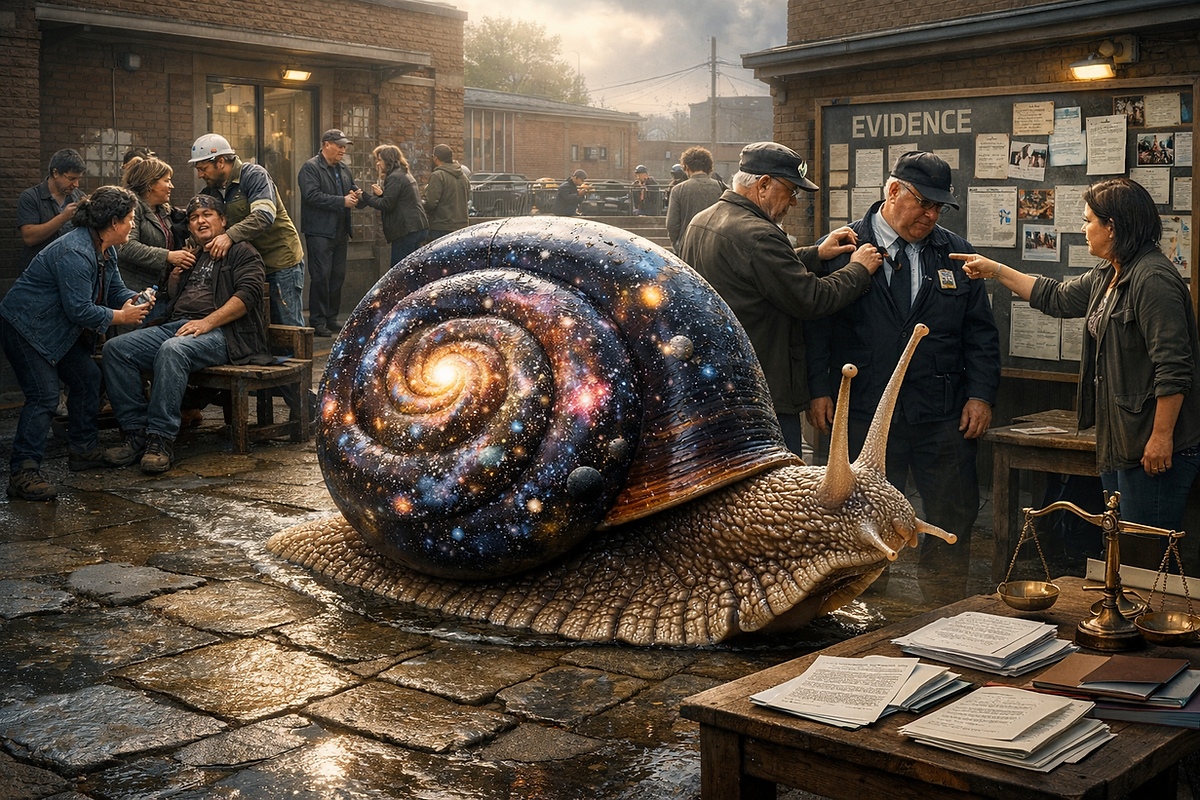
The snail, a gentle creature of the earth, represents patience and steady progress. For Mystrikism, it crystallises our commitment to naturalism and shows our pledge to remain grounded in a reality that can be observed, felt, and scientifically understood.
In the fable of the Tortoise and the Hare, the slow animal wins by moving forward with steady determination. In the same way, our approach is to keep asking questions. We are not tempted by quick but unproven ideas; instead, we are strengthened by careful, logical thought.
Our icon's spiral shell represents patterns found in nature and the universe. These spirals appear in galaxies, seashells, weather systems, and in the draining of water. The spiral symbolises our connection to such natural patterns and expresses the cycle of growth and evolution.
Look closely, and you’ll notice the snail's head tilted upward in optimism, a subtle embodiment of our collective positive outlook and curiosity. The snail’s antennae, acting as investigative sensors, reach out to the world with eagerness. These antennae symbolise our community’s persistent quest for truth and discovery.
Our icon reflects our belief system: a snail, grounded yet guided by the stars, inspires us to explore existence with optimism, curiosity, and respect for both reason and wonder.

Why the Name?
🎧 Audio Version 🎧
"Mystrikism" is a portmanteau, a blend of two words into one, in this case combining "mystery" with "metric," representing a unique juxtaposition to our worldview. While "mystery" suggests the unknown, ineffable, or unexplainable, "metric" denotes measurement, quantification, and logical methods of understanding. Thus, "mystrikism" signifies an endeavour to apply measurable and analytical methods to uncover the unknown aspects of reality while holding in reverence the profound mystery for what remains yet to be discovered.

What Does it Mean to be Aweistic?
🎧 Audio Version 🎧
Sociologist Phil Zuckerman coined 'Aweism' in his book 'Living the Secular Life.' Aweism is an existential wonder and appreciation that, according to Zuckerman, connects secular individuals, non-theists, humanists, agnostics, and sceptics - to one another and to the universe. He calls it a "profound, overflowing feeling" in significant moments, like a naturalised spirituality not tied to theism or superstition.
Zuckerman's Aweism counters the view that secular people lack emotional depth, demonstrating that awe is possible without supernatural beliefs. It offers nonbelievers a positive identity and suggests that many secular individuals connect with these principles.
Experiences of Aweism involve a sense of wonder or connection, often found in everyday events, in nature, or in encounters with the unknown.
These moments are highly personal, with examples including:
-
Witnessing a breathtaking sunset, a star-filled sky, a thunderstorm, or the serene beauty of a forest.
-
Feeling moved by music, art, literature, or a meaningful performance.
-
Feeling awe at the enormity of the universe, life's complexity, or scientific discovery.
-
Strong bonding moments, such as a child's birth, a wedding, or reuniting with a loved one.
-
Participating in or witnessing acts of compassion, courage, or altruism that reveal humanity's best.
-
Standing before ancient ruins, historical sites, or marvels of architecture that link to the past or human achievement.
-
Reaching personal goals, overcoming challenges, or achieving significant life milestones.
-
Times of quiet reflection or solitude, bringing peace and a sense of connection to self or world.
Such moments deepen appreciation for life and expand one's view of the universe, all without invoking the supernatural.

Why is Justice Vital to Mystrikism?
🎧 Audio Version 🎧
Justice is vital to Mystrikism because it unites logical foundations with moral value. In Mystrikism, justice has two key aspects: it is rooted in rationality and logic, and it holds ethical worth that is not exhausted by rational justification. Kindness is one of the primary humane expressions of justice in this philosophy. It leads to harmony, trust, cooperation, fairness, and equity, both immediately and over time. Compassion helps create social harmony and trust. This illustrates the rational basis for justice in Mystrikism. Kindness is essential for building strong, cohesive communities. Providing sociological evidence strengthens this point. Consistent empirical findings show that kindness and altruism, beyond being moral ideals, produce measurable, stabilising effects on social environments. This demonstrates that kindness is a logical and necessary component of justice.
Building on the rational foundation of justice, compassion brings warmth, humanity, and sustainability to Mystrikism. It softens the sharp edges of strict logic and reason. Logic and reason can turn cold and harsh without the influence of kindness. Compassion is a key counterbalance, keeping justice humane. Without sufficient ethical concern for individual welfare, practices like eugenics, offensive military technologies, and animal testing can more easily be justified or pursued without adequate restraint. The Journal of Law and the Biosciences states that superiors must safeguard those under their command. They must ensure any risks are justified by possible benefits. The principle of reciprocity also provides a logical foundation for kindness as part of justice. This basic human interaction shows that kind behaviour often encourages positive responses, starting a cycle of care and support. Compassion is not just moral or emotional; its two-way nature makes it a logical, sustainable approach to positive social exchange. Evolutionary biology also supports the rationality of kindness. Traits such as sympathy and partnership have been important to human development. This suggests that kindness is more than a moral choice. It helps with survival, progress, and the maintenance of just societies.
Alongside these foundations, the emotional and mental impacts of kindness include a better mood, reduced stress, and enhanced well-being. These benefits go beyond merely logical advantages, such as social harmony. They point out the human capacity for compassion and the role of kindness in justice. Some critics claim that prioritising kindness may cause harmful behaviours or undermine accountability if it is given without critique. Addressing this means admitting that compassion is fundamental to both character and community ethics. It promotes humility and sympathy, but must be applied carefully. Kindness acts as an international language that connects cultural and social divisions, further emphasising its importance for global understanding and peace. In a divided world, kindness acts as a key tool for justice, practical and valuable when balanced with critical discernment.
With these considerations in mind, being evenhanded in justice means recognising both the rational and human value of decency. Adding care and consideration to daily decisions promotes the logic of kind behaviour and emphasises its inherent value as a human trait. Compassion may prove transformative in personal and workplace life by deepening bonds and creating teamwork. Kindness drives positive change and shows its effectiveness as a humane tool for justice.
However, kindness alone is not always enough in Mystrikism. Sometimes, relying only on kindness can lead to harm or exploitation. For example, forgiving a community member who repeatedly behaves harmfully can let misconduct continue. To confront these problems, Mystrikism holds that justice is expressed through a combination of kindness, principled disgust, and ethical opposition. Kindness means caring for people. principled disgust brings a rational resistance to cruelty, deception, or repeated harmful behaviour. Ethical opposition is the response to wrongdoing. For instance, if a leader abuses authority to exploit others, principled disgust helps the community recognise and stand against such acts, preventing excuses in the name of compassion. Together, kindness and principled disgust work to maintain boundaries — kindness prevents harsh treatment, while principled disgust and ethical opposition set clear limits for behaviours that must be stopped. By setting fair consequences for repeated harm while upholding dignity, compassion stays connected to justice. Neither unchecked forgiveness nor disproportionate harsh treatment controls the response.
To further clarify, such ethical resistance must always remain adaptive, proportionate, and evidence-based. Mystrikism requires that actions motivated by principled disgust comply strictly with these safeguards. This prevents justified aversion from devolving into destructive hostility or blind retaliation. Ethical opposition should not be automatic or dogmatic. Instead, it demands constant review and reflection. The intensity and form of our resistance must always match the severity and aim behind the harmful actions we oppose. This should be grounded firmly in verified evidence rather than emotional impulse or assumption.
Some critics say proportionality and pliability seem subjective. They argue this risks inconsistent ethical standards. Others suggest that even evidence-based decisions may carry bias. These concerns illustrate the challenges in applying ethical models. Mystrikism tackles this by stressing transparent reasoning and joint assessment. For example, it recommends clear, documented criteria and frequent public review of evidence and decisions. This openness welcomes scrutiny, reduces bias, and incorporates a variety of perspectives. By using collective deliberation, clear criteria, and continuous reflection, Mystrikism aims to reduce bias. It seeks to improve consistency and adapt its practices toward new challenges and evidence.
By using flexibility, fairness, and verifiable facts in our ethical choices, and by talking openly about problems, Mystrikism keeps justice caring, logical, and true to its values. This continued commitment strengthens Mystrikism’s approach to realising justice in complex situations.
Justice in Mystrikism combines rational need and principled ethics. It is expressed through kindness, compassion, fairness, and principled opposition. Rational aspects facilitate social harmony, while lived value enriches human experience. This approach argues that kindness is a core tool for justice, but not the sole ethical standard. Thus, justice in Mystrikism is an ethical necessity within its stated aims. It is realised, in part, through deliberate acts of kindness and principled defiance.
Why Do We Uphold The Scientific Method?
🎧 Audio Version 🎧
Mystrikism embraces the principles of science, led by the scientific method and informed by verificationism and falsificationism, as its core system for determining the best current provisional understanding of objective truth about the universe. This commitment stems from recognising the inevitable human errors, such as perception biases, memory lapses, ego, pride, mental biases, and susceptibility to persuasive rhetoric, that cloud our acquisition of knowledge and wisdom.
Addressing Human Fallibility
Connecting Mystrikism's foundational adherence to scientific principles with the pragmatic challenges of human reasoning, we consider how the scientific method tackles these limitations.
Human mental processes are error-prone and formed by biases, desires, and persuasive stories. The scientific method, defined by systematic observation, experimentation, and analysis, guides us past these pitfalls. By insisting on measurable data and repeatable results, it reduces individual bias and subjectivity, striving for objectivity.
Verificationism and Falsificationism as Foundations of Inquiry
Building upon the scientific method's role in limiting bias, two philosophical approaches further strengthen the foundation of objective investigation within Mystrikism.
Verificationism states that only empirically verifiable statements matter, urging direct engagement with reality. This ensures accepted theories are grounded in observable facts, not speculation. Falsificationism, in contrast, demands hypotheses be testable and refutable—essential for integrity, as it acknowledges knowledge is always provisional and open to revision.
Embracing Intellectual Honesty
Following the discussion on philosophical pillars, the unification of these approaches promotes an environment prioritising truth-seeking over certainty.
By uniting these approaches, Mystrikism builds a culture where logical honesty trumps false certainty. This method embraces the limits of human knowledge and the constant risk of error, valuing ongoing inquiry above the pursuit of unattainable absolutes. It demonstrates humility that knowledge evolves, as must community beliefs and doctrines.
Responding to New Insights
Continuing this focus on intellectual honesty, it is essential for Mystrikism to continue to be adjustable in the face of emerging knowledge.
The scientific method’s adaptability, supported by verificationism and falsificationism, keeps the Union receptive to new discoveries. This readiness is essential in a constantly changing world in which science continually expands our insight into and awareness of reality. It shows a devotion to growth, learning, and evolving thought, unchained by dogma.
Mystrikism’s support for the scientific method, verificationism, and falsificationism demonstrates a deep devotion to exacting, open search for knowledge, and a frank acceptance of our limits. This approach leads the community toward empirical truth and champions a philosophy grounded in humility, adaptability, and freedom from ego, bias, and unfounded claims. Through this lens, Mystriks seek to grasp the universe’s complex intricacy.

Introduction to The Naturalism of Mystrikism
Mystrikism rests on a provisionally naturalistic worldview that encompasses four major forms of naturalism, each with a specific philosophical meaning. Metaphysical naturalism is the view that only natural entities and processes exist; there is nothing beyond the natural world. Methodological naturalism holds that scientific inquiry should explain phenomena by reference to natural causes, deliberately excluding supernatural explanations as a matter of method. Epistemological naturalism is the position that knowledge originates from empirical investigation and observation of the natural world, rather than from revelation or intuition. Mystrikism's ethical naturalism begins with moral ends chosen by valuing minds and uses natural facts, evidence and disciplined reasoning to evaluate the means by which those ends can best be pursued. Mystrikism sees the universe as governed by discoverable natural laws and processes, and requires claims about observable reality to answer to relevant evidence and testing where applicable, while conceptual, mathematical and normative propositions require appropriate forms of reasoning and justification. The Union of Mystriks rejects paranormal or supernatural phenomena, stressing that science and observation are our strongest tools for investigating empirical reality, complemented by sound reasoning and other domain-appropriate methods of justification.
Naturalism holds that only natural laws shape the universe, excluding supernatural forces and superstition. Various philosophies embrace naturalism, including Humanism and Scientific Naturalism. Humanism centres human welfare and reason as the basis for meaning and morality within a naturalistic universe, while Scientific Naturalism emphasises science as the sole valid method for discovering truth about reality. Mystrikism brings these elements together as follows: provisional naturalistic physicalism is its present worldview; methodological naturalism is the working method of empirical science; evidence and reason form its broader epistemic orientation; and ethical naturalism uses natural facts to guide means toward openly declared moral ends. However, unlike standard Humanism, Mystrikism incorporates "Aweism", highlighting the sense of wonder and "Spirituality" (in quotes) rooted in the natural world, and uniquely emphasises the union of scientific rigour with an appreciation for the mysterious and awe-inspiring aspects of nature. Together, these aspects promote curiosity, logic, and evidence over superstition. As Richard Dawkins said, “The universe we observe has precisely the properties we should expect if there is, at bottom, no design, no purpose, no evil, no good, nothing but blind, pitiless indifference".
Because Mystrikism provisionally treats everything presently established to exist as natural or physically realised, while withholding belief in supernatural claims that have not earned sufficient justification, it agrees strongly with metaphysical naturalism by excluding any supernatural, unverified, or unfalsifiable realm. Still, Mystrikism does not stop there; it recognises that understanding nature also demands the principles of methodological and epistemological naturalism. If an event once labelled “supernatural” can be repeatedly demonstrated under methodical scrutiny, then it simply becomes another natural occurrence. Hence, Mystrikism remains open to extending its understanding of reality, provided the evidence is replicable and reliable.
It is worth acknowledging, however, that naturalism has faced several philosophical criticisms, including the claim that empiricism cannot fully account for abstract concepts such as mathematics, logic, or subjective experiences. Critics also question whether naturalism might limit inquiry by dismissing alternative ways of knowing. Mystrikism responds to these concerns by maintaining that, while empirical investigation is central, it does not ignore the importance of reason, theory, and interpretive frameworks that help explain phenomena not strictly empirical. Rather than dismissing these challenges, Mystrikism seeks to engage in rigorous discussion of the limits of empiricism, remaining cautious and self-reflective about what science and observation can and cannot presently explain.
Ethical naturalism additionally shapes Mystrikism’s moral stance.
Scientific and social research reveal what fosters human flourishing. Values like justice, honesty, and compassion arise not from supernatural authority but from their real benefits. This grounds Mystrikism’s ethics in reason and measurable well-being. However, Mystrikism recognises that the limits of empirical inquiry can sometimes leave moral dilemmas unresolved, especially when evidence about well-being is ambiguous, incomplete, or contested. In such cases, Mystrikism advocates reasoned debate, careful analysis of potential consequences, and openness to revising moral judgments as new information emerges. It emphasises humility and critical reflection, acknowledging that some ethical questions may require an ongoing search for better evidence or deeper understanding before resolution is possible.
Some fear that firm trust in natural explanations eliminates life’s magic, but Mystrikism responds with “Aweism", affirming natural "Spirituality" (in quotes). By accepting nature’s complexity and the unknown, Mystrikism welcomes moments that exceed the ordinary.
Philosophers such as Immanuel Kant and Edmund Burke have explored the profound sense of awe and the sublime when encountering the vastness and beauty of nature. Kant described the sublime as an experience elicited by greatness beyond our capacity to comprehend, inspiring both reverence and humility, while Burke emphasised how the sublime in natural settings arouses intense emotion and admiration. Mystrikism draws on these philosophical insights to ground “Aweism” as a perspective that recognises the power and majesty of nature as central to "Spiritual" (in quotes) feeling. Awe, rooted in nature, inspires curiosity instead of superstition. Rational inquiry, far from draining wonder, heightens it. The more we discover, the more extraordinary the universe becomes.
Thus, Mystrikism’s allegiance to all four aspects of naturalism, metaphysical, methodological, epistemological, and ethical, forms a sturdy framework for living ethically and celebrating the universe’s wonders, all without calling upon the supernatural. By reminding us that we stand as integral parts of a natural, ever-evolving cosmos, it urges humility in what we do not know, and confidence in the energy of human exploration, evidence, and justice. In short, Mystrikism unites logic and awe, forming a path which values honesty and insight, while finding "Spiritual" (in quotes) depth in the enigmas of nature itself.

Why Are We Agnostic Non-Theists?
🎧 Audio Version 🎧
Investigating the complexities of reality, questions of belief, knowledge, and the supernatural have for a long time captivated human thought. Mystrikism’s adoption of a naturalistic, agnostic, non-theistic, non-religious stance stems from its devotion to empirical evidence, logical coherence, and the scientific method. Our position reflects an understanding of the restrictions of human knowledge, specifically about claims about god(s). We pilot the tension between reason and speculation, seeking truth through a disciplined and rational framework.
By "non-religious," we mean those who do not adhere to a specific religion; however, some forms of non-theism, such as certain branches of Buddhism, are generally considered religious.
Atheism actively rejects the existence of gods. Non-theism involves a conditional absence of belief, sometimes seen as a provisional absence without absolute claims. This less confrontational stance matches Mystrikism’s values of humility and scientific openness.
Distinctions between 'a-' and 'non-' are generally accepted in academic circles, especially among linguists. 'A-' usually means complete absence or negation. For example, "apathetic" means lacking emotion or interest entirely. 'Non-' means "not" or "outside of" a category, or lacking a quality, but not full negation. For example, "nonsmoking" describes a place without smoking, but does not deny that smoking exists elsewhere.
Some say non-theism is like weak atheism. Both reject active belief in gods and recognise that this position is provisional. However, "weak atheism" may imply insufficiency. Mystrikism prefers non-theism as a more precise term. It means not just an absence of belief in gods but also a thoughtful, open approach.
By accepting non-theism, we prioritise naturalism and inquiry instead of theological debate. This promotes intellectual flexibility and a more adjustable approach to the universe's mysteries.
The Foundations – Verificationism & Falsificationism
Building on this system, our agnosticism acknowledges epistemic limits. We recognise that a lack of measurable data and irrefutable logic constrains human knowledge of the divine and the paranormal. Verificationism holds that a claim is meaningful only if it is verified by the methods of science. Claims about gods or supernatural phenomena fail this test, remaining mere speculation. Thus, our agnosticism is not tentative but a reasoned conclusion based on available evidence.
The Union pushes this scepticism further, based on the idea of falsification. Falsification means that for a claim to be scientific, or even a hypothesis, it must be possible to imagine something that could prove it wrong. Religious ideas, by nature, avoid falsification because they claim things like all-powerfulness or being everywhere. They are described in ways that keep them outside testing and proof, beyond what we can see or measure. This means untestable ideas stay unproven at best and fantasies at worst. Scientists often call such ideas "not even wrong" because they cannot be tested or seriously discussed in science.
As a result, these conclusions lead us to non-theism. Despite millennia of effort, the god hypothesis has never been scientifically verified or falsified. The breadth, impact, and implications stemming from this idea demand strict adherence to the principles of science. This position is not simply a procedural preference, but a core imperative. Claims about supernatural or paranormal forces profoundly affect our insight into the universe and our place in it. Thus, our agnosticism with naturalism leads us to non-theism: because we do not know, we do not believe.
A Stance of Sceptical Openness
Following non-theism grounds, our perspective is grounded in reason. Mystrikism provides a philosophical and "spiritual" framework through which we explore existence with scepticism and openness. Each journey is individual, yet we seek answers through scientific method, empirical evidence, and logical coherence. Non-theism is not a goal, but a continuous provisional conversation with reality, exemplifying our persistent quest for knowledge and humility.

Why Do Mystriks Revere the Unknown?
🎧 Audio Version 🎧
Mystriks revere the unknown because it is the most honest and humbling "higher concept" we have. It is not a deity, hidden intelligence, or supernatural force, but the vast, dynamic mystery of reality beyond full comprehension. This reverence is not worship, devotion, or submission. It simply means deep respect and awe for that which is much greater than ourselves. The unknown gives us perspective about human self-importance, tempers pride, humbles egotism, and reminds us how small our certainties are.
From the earliest stages of human history, mystery surrounded us. Death, disease, storms, darkness, suffering, the randomness of nature, and the silence beyond explanation all weighed on the mind. Our ancestors often responded with fear, myth, spirits, gods, and imagined realms beyond nature. These were early attempts to explain, soften, or control what could not be understood.
As humanity matured, a better response appeared. Instead of plugging gaps with stories, we began to investigate reality more honestly. Science did not erase mystery. It revealed that reality is even stranger, deeper, and more magnificent than superstition ever imagined. Each genuine discovery leads to new questions. Solved mysteries reveal new frontiers. The unknown did not shrink. It became the horizon that expands as we move toward it.
Mystrikism recognises this shift as growth. Our ancestors’ fear of the mysterious was understandable. But today, fear is not the noblest response. Reverence is. To a Mystrik, the unknown is not a cosmic being with preferences, intentions, awareness, or plans. It has no mind, agency, personality, or agenda. It is not magic or divine. It is the still-unmastered immensity of existence, the immeasurable remainder beyond what we know, can test, or can imagine. This warrants deep respect and awe.
This veneration also serves a practical and philosophical role. It keeps us honest. It reminds us that certainty should be earned, not assumed. It helps guard against arrogance, dogma, wishful thinking, and the urge to pretend we have final answers. In that sense, reverence for the unknown is not a retreat from reason. It is its ally. It encourages humility, curiosity, and a willingness to improve our understanding as evidence and methods develop.
For a Mystrik, the unknown is not just something to accept. It is also what gives life enduring purpose. If reality were fully solved and all truth were already known, the adventure of understanding would be over. But that is not our situation. We live short lives in the presence of endless questions. This is not a defect in existence. It is one of its most beautiful features. The unknown keeps meaning alive by calling us to explore, learn, question, discover, and always push the boundary of understanding further.
It is also deeply tied to Mystrikism’s naturalised “spirituality”. The same unknown that humbles us can similarly inspire us. When we stand beneath a star-filled sky, see the elegance of nature, hear moving music, or encounter a meaningful truth, we feel awe, wonder, and connection without calling upon anything supernatural. Those instances do not point away from reality. They root us more deeply in it. They show us that the natural world is already more than enough to evoke the kinds of feelings often explained through religion.
Mystriks revere the unknown: real, vast, humbling, inspiring, inexhaustible. It corrects arrogance, is inquiry’s frontier, and the silent backdrop of honest wonder. We don’t fear it as ancestors did, nor deify it as religions have. We respect and marvel at it. In doing so, we find perspective and purpose in our search for the best current provisional approximation of objective truth.

How did Mystrikism get started?
🎧 Audio Version 🎧
Mystrikism began with a fairly simple frustration: humans have always been surrounded by mystery, but for most of our history we tried to explain that mystery with spirits, gods, omens, myths, and frightened guesses cosplaying up as certainty.
That is not hard to understand. Early humans were barely out of the Savannah, staring at storms, death, disease, dreams, hunger, birth, stars, predators, and each other. They did not have microscopes, telescopes, germ theory, neuroscience, evolutionary biology, or any reliable method for testing what was true. So they told stories. Some of those stories gave comfort. Some gave order. Some became culture. Some became cages.
Mystrikism starts from the view that we have outgrown the need to treat those old explanations as sacred simply because they are old. We now have better tools. The Scientific Method, along with careful reasoning and honest doubt, gives us a way to separate what we know from what we merely feel, assume, hope, or fear. It does not answer everything. It does not pretend to. But it gives us the cleanest way we have found to investigate reality without smuggling our favourite conclusions into the gaps.
The larger questions still matter: Why are we here? How should we live? What should we value? What do we do with awe, grief, love, death, beauty, and the strange fact that we exist at all? Mystrikism does not want to flatten those questions into cold machinery. Quite the opposite. It says those questions deserve more honesty, not less. They should not be handed over automatically to ancient supernatural claims just because those claims got there first.
There are plenty of people who feel something deeply “spiritual” in life, but do not believe in gods, souls, miracles, cosmic judgement, or invisible realms. They may feel it under the stars, beside the ocean, in music, in love, in grief, in the scale of deep time, or in the sheer weirdness of being a conscious animal on a small planet. Mystrikism gives that experience a home without forcing it through supernatural language.
That is where Aweism comes in. Aweism is Mystrikism’s name for naturalised “spirituality”: the sense that reality itself is enough. The universe does not need to be enchanted by gods to be astonishing. A galaxy does not become more beautiful because someone imagines a deity behind it. A human life does not become more precious because it is placed inside a religious story. The real thing is already staggering.
Mystrikism also arose because rational “spiritual” people can feel oddly homeless. Traditional religion often dominates the language of meaning, ritual, reverence, and community. Meanwhile, non-religious spaces can sometimes act as if awe and “spirituality” are embarrassing leftovers from religion, best avoided. Mystrikism rejects that false choice. We can be rational without being emotionally flat. We can be deeply moved by existence without pretending the universe is conscious, loving, judging, or watching.
So Mystrikism began as a response to an old human habit: filling the unknown with supernatural certainty. But it is also a positive project. It is an attempt to build a way of life around honesty, reality, ethical seriousness, and wonder. Not wonder as an excuse to stop thinking, but wonder as one of the best reasons to keep going.
The mystery is still there. We just do not have to kneel before it.

The Purpose Behind the Values of Mystrikism
🎧 Audio Version 🎧
Mystrikism rests on two demands that are not very glamorous, but matter enormously. Justice and honesty.
Justice matters because people cannot properly explore reality while they are being crushed, excluded, deceived, exploited, or forced to spend their lives fighting for the basics. A mind under constant threat does not get much room to wonder about the cosmos. It is too busy surviving.
So fairness is not just a nice social preference. It clears space. It gives people room to think, learn, create, disagree, repair, and take part in the larger human project of understanding where we are and what this strange universe actually is. The more people who are allowed into that project, the better. Each mind sees from a slightly different angle. No one gets the whole picture alone. We need each other’s view of the mountain, so to speak, even when some of those views are awkward, partial, or hard to fit together.
That shared effort is part of the beauty of life. Not some syrupy, greeting-card beauty, but the real thing. Fragile minds, on a small planet, trying to understand a reality far bigger than themselves.
Honesty matters just as much. Without it, wonder turns into fantasy. We start mistaking fear for insight, hope for truth, confidence for knowledge. Mystrikism treats science as the most reliable tool we have for pushing past our ego and getting closer to the best approximate truth. Not perfect truth. Not final truth. Just the best answer reality will currently allow us to earn.
That matters because beauty is cheapened when we have to lie to protect it. The universe does not need our inventions to be magnificent. It is already more than enough: strange, vast, brutal, delicate, and astonishing without any supernatural embroidery stitched over the top.
The deeper purpose of Mystrikism’s values is to help us meet that reality properly. To look at the unknown without pretending we own it. To feel awe without surrendering our honesty. To build a fairer world because more minds deserve a chance to take part in the search.
The infinite unknown is the closest thing Mystrikism has to a “higher power”, though not a mind, not a god, and not something that wants anything from us. It simply dwarfs us. It puts our pride in its place. We are brief, fragile creatures with a narrow grip on reality, crawling through a cosmos we barely understand.
And still, somehow, we get to look. That is the point. Not certainty. Not worship. Not escape. Exploration, honesty, justice, and awe. Held together as best we can.

The Unknown: Our Higher Power and Purpose
🎧 Audio Version 🎧
When Mystriks talk about a “Purpose to Life” or a “Higher Power,” we are not trying to sneak religion back in through the side door. The centre of it is the unknown: not a god, not a cosmic mind, not some invisible authority watching from behind the curtain, but the vast part of reality we have not yet understood.
There is a strange balance here. We live inside the known world, using evidence, reason, science, memory, language, and all the other fragile tools humans have managed to sharpen over time. But around that little island of knowledge is an ocean we have barely begun to map. Mystrikism does not treat that ocean as proof of the supernatural. It treats it as a reason to stay curious, careful, and awake.
A Power Greater Than Ourselves
For Mystriks, the closest thing to a “higher power” is the dynamically infinite unknown itself. That does not mean we worship it. Worship would be the wrong word. We revere it. We stand before it with awe, not obedience. We recognise that reality is larger than us, older than us, stranger than us, and completely uninterested in flattering our egos.
A god can become a projection of human certainty. The unknown does the opposite. It keeps cutting us back down to size. It reminds us that our favourite explanations might be wrong, our knowledge is unfinished, and our little human dramas are happening inside a universe so immense that even our best words start to wobble. That is not bleak. I find it oddly freeing.
The unknown gives us something larger than ourselves without asking us to believe in ghosts, miracles, divine punishments, or cosmic supervision. It gives humility without superstition. It gives awe without pretending awe has a mind behind it.
This can matter very practically for people in recovery programs, especially those who struggle with the language of a “higher power.” Someone in Alcoholics Anonymous, for example, may feel blocked by the idea that surrender or humility has to involve God. Mystrikism offers another route. You can admit you are not the centre of reality. You can draw strength from something larger than your own cravings, habits, pain, and private chaos. You can be humbled by the scale of existence itself. No deity required.
The unknown is not soft or sentimental. It does not comfort us by promising that everything happens for a reason. It asks for something harder: honesty. It asks us to look at reality without flinching, and still find wonder there.
To revere the unknown is to feel the weight of mystery without rushing to decorate it with mythology. It is the feeling someone might have staring into deep space, holding a fossil, watching a child learn language, sitting beside a dying loved one, or realising that matter somehow became conscious enough to ask what matter is. Those moments do not need supernatural packaging. They are already astonishing.
The Meaning of Life
The old religious question is familiar enough: Why are we here? Mystrikism does not pretend to have the final answer tucked away in a sacred book. It starts more honestly. We do not know. That answer can sound disappointing if you were hoping for certainty. But it also clears the table. Once we stop pretending the answer has already been delivered from above, we can begin the search properly.
For Mystriks, meaning is not handed down. It is made, discovered, revised, and deepened through the act of engaging with reality. We find purpose in the search itself: in uncovering what was hidden, correcting what was false, learning what we did not know, and letting reality change us when it must.
Every mystery we unmask gives us something. Sometimes it gives us beauty. Sometimes it gives us useful knowledge. Sometimes it takes away an illusion we were far too attached to. That can sting a bit. Still, there is dignity in wanting to know what is real, even when the answer is not warm and cuddly. The search is not a consolation prize for not having divine certainty. It is the work.
We are tiny creatures on a small planet, poking our heads into the dark and trying to understand where we are. There is something almost absurd about that, but also magnificent. We do not need to pretend we already found the treasure chest. The map is still being drawn, the stars are still overhead, and there is more than enough mystery left to keep us moving. That is purpose enough to begin with.

The Trinity of the Unknown
🎧 Audio Version 🎧
Human beings have always lived beside the unknown. We feared it, worshipped it, studied it, told stories about it, and sometimes pretended we had solved it when we absolutely had not. Mystrikism takes a different route. While it has roots in naturalism and shares naturalism’s inference that reality is governed by natural laws rather than supernatural forces, Mystrikism accepts this view because natural explanations have consistently shown greater predictive reliability and explanatory power than supernatural claims. Its distinct focus, however, is the unknown itself as a source of meaning and inspiration. Like existentialism, it acknowledges uncertainty and embraces the search for individual purpose, but it finds value in the mystery itself rather than in creating fixed answers.
Mystrikism is also similar to agnosticism in its admission of what cannot be known, but goes further in framing the unknown not as a problem to be solved, but as something to be respected and approached with deep curiosity. It does not treat the unknown as a hiding place for gods, spirits, cosmic minds, or supernatural forces. It treats the unknown as the great open edge of reality: the thing that keeps us curious, humble, and awake. In that sense, the unknown sits at the centre of Mystrikal meaning, purpose, and naturalised “spirituality.” It is not an answer. It is the reason we keep asking better questions.
Facet 1 - Aweism: rational inspiration
Aweism is the Mystrikal response to those moments when reality stops feeling ordinary. Standing under a huge night sky. Watching an eclipse. Hearing a piece of music that seems to hit some deep, wordless part of you. Sitting quietly and thinking about how strange it is that anything exists at all. These experiences can feel “spiritual” without needing a supernatural explanation tacked on.
There are plenty of physical pleasures we understand reasonably well: a good meal, sex, exercise, warmth, and sleep. They are real and valuable. No need to be a gloomy little monk about it. But Aweism points to a different sort of experience, the kind that feels bigger than ordinary satisfaction. It has wonder in it. Sometimes joy. Sometimes even a little existential vertigo.
Mystrikism does not claim these experiences come from another realm. They arise from natural beings encountering a natural universe that is still far beyond full comprehension. The feeling is real. But interpretation still has to behave itself: that means we do not get to explain these moments by inventing supernatural forces or stretching the facts to fit personal wishes. Our interpretations, however meaningful, should stay within rational and empirical boundaries. We honour the experience, but remain honest about what can truly be known. Aweism, then, is not supernatural “spirituality.” It is the honest awe of a mind that knows it is standing in front of something immense.
Facet 2 - Purpose: the search that never really ends
Mystrikism does not reduce life’s purpose to merely the preservation of life and the pursuit of pleasure. Those are biological facts, not the whole story of what sapient beings can become. For Mystriks, one of the deepest purposes of intelligent life is to uncover and understand the unknown. We are creatures that ask. We pull things apart, test them, name them, map them, argue about them, and then discover that the map was only a corner of the territory. Science shows this beautifully. Every major discovery answers something, but it additionally raises new questions. The atom was not simple. Space was not empty. Life was not fixed. The mind is not transparent to itself. Reality keeps refusing to be small enough for our comfort. That is part of the point.
This search shows up everywhere: in scientists probing matter, in astronomers looking into deep time, in people trying to understand consciousness, grief, memory, language, or why music can make the chest tighten. Not all inquiry happens in a laboratory, though the laboratory remains one of our best tools. Sometimes the search begins with a telescope. Sometimes with a microscope. Sometimes, a child asks an annoyingly good question at the dinner table.
Carl Sagan put it beautifully: “We are a way for the cosmos to know itself.” Symbolically, that line fits Mystrikism almost perfectly. Human consciousness is not magic, but it is still extraordinary. Matter has organised itself into beings that can look back at the universe and wonder what it is. That does not make us the centre of existence. If anything, it should knock that idea out of us. But it does give our curiosity a kind of natural dignity. We are not here to pretend we already know. We are here to keep finding out.
Facet 3 - The infinite unknown as our “Higher Power”
For a Mystrik, the unknown is treated as the only kind of “Higher Power or Concept” a naturalistic philosophy can honestly accept. That phrase can sound dangerous if it is handled badly. It can easily drift into religious language. Some may object that equating the unknown with a 'Higher Power' risks slipping back into metaphysical territory, or simply dressing old ideas in new clothes. This is a valid concern and deserves to be taken seriously. The intention here is not to sneak in supernatural assumptions, but to acknowledge that what lies beyond our knowledge is immense and powerful in a natural sense, not a mystical one. The unknown is not a person. It has no mind, no will, no plan, no moral agenda, and no interest in our little dramas. Yet it is greater than us.
The scale of what we do not know is enough to humble any honest person. It gives our pride, ego, and hubris the domestication they badly need, placing them back inside a wider and more honest perspective and sensible proportion. Our lives are brief. Our senses are limited. Our brains are useful but flawed. Our theories are powerful, yet always incomplete, flawed, and provisional. Even our best knowledge is surrounded by a border of ignorance. For a sceptical, naturalistic person, this may be the only “Higher Power” that makes sense: not a supernatural ruler, but the immensity of reality beyond our present understanding, not to mention awareness. That is not mystical fog. It is a sober recognition of our position.
Scientific history keeps teaching the same lesson. We explain one thing, and the explanation exposes a deeper structure. We solve one problem, and the solution creates sharper questions. Good science does not abolish mystery; it refines it. It turns vague wonder into better wonder. In Mystrikism, reverence for the infinite unknown supports humility, honesty, and awe. It asks us to admit what we do not know without rushing to occupy the silence with comforting inventions. It also pushes us forward. The unknown is not something to kneel before. It is a natural aspect of reality - to be faced, studied, respected, savoured and ultimately unveiled.
What the Unknown Gives Us
Mystrikism reframes the infinite unknown as a natural source of meaning, not a metaphysical object floating beyond reality. For example, when faced with an ethical dilemma at work, like deciding whether to speak up about a mistake that could affect a project's outcome, a Mystrik might draw inspiration from the idea that admitting what is unknown or uncertain is itself an act of integrity. Instead of claiming certainty, they would favour honesty, curiosity, and openness to learning, even if it means sitting with uncomfortable questions. In practical terms, this could mean choosing transparency over self-protection, or approaching disagreements with a genuine willingness to understand perspectives that have not yet been considered.
The unknown becomes a reminder to keep questioning, keep learning, and keep acting in good faith, rather than clinging to certainty. It does not need souls, heavens, divine plans, or hidden supernatural machinery. It begins with a simpler and, frankly, more honest admission: we do not know everything. Not even close. That admission is not bleak. It is energising. The unknown gives us work to do. It gives science its horizon, philosophy its bite, art its depth, and personal growth some room to breathe. It reminds us that certainty is often cheap, while understanding is usually earned the hard way.
Reverence, here, is not passive worship. It is not a misty-eyed surrender. It is the posture of a finite mind before an unfinished universe, choosing respect and curiosity over fantasy. That is Mystrikism’s Trinity of the Unknown: awe without superstition, purpose without divine command, and a “Higher Power” without a god behind it. Not a final answer. A reason to keep looking.

The True Test of Justice
🎧 Audio Version 🎧
Justice is often mistaken for punishment, hardness, or cold moral calculation. In Mystrikism, though, justice has a warmer and more demanding meaning. Mystrikism is a sensible, syncretic philosophical discipline built around clear thought, ethical adaptability, and the joining of reason with compassion. It tries to balance kindness and firmness as tools for justice, guided by evidence and by a commitment to reducing suffering and enhancing well-being for sapient beings, sentient life, and ecosystems.
For a Mystrik, kindness is not the final aim on its own. It is one of the default tools of justice. Often the first tool. Often the best tool. But still one tool among many.
Justice is most revealing when it is hard to practise. It is easy enough to be kind when kindness is returned, noticed, or praised. That is still good. It creates trust. It makes ordinary life less miserable. But it does not really test the depth of our principles. The harder test comes when kindness costs us something: when pride is bruised, when someone has acted badly, when fairness is inconvenient, or when compassion risks becoming an open door for exploitation.
Most of us know the feeling. Someone talks down to you. Someone embarrasses you. Someone pushes right on the sore spot, and suddenly the animal part of the brain wants to bite back. That is the moment where kindness itself, used as an instrument of justice, becomes more than politeness. It becomes self-command.
When someone least seems to deserve kindness, beginning with patience or restraint may still lead to the most just result. Not always. But often enough that a Mystrik should try it before reaching for something harsher. A calm response can break the rhythm of hostility. It can leave room for apology, correction, or repair. Retaliation usually just teaches everyone to reload.
Still, justice is not passive. It is not sentimental forgiveness with no boundaries. It is not standing there smiling while cruelty, dishonesty, or exploitation keeps rolling along. Mystrikal justice asks a harder question: will kindness actually help here, or will it protect the person doing harm from the consequences of their behaviour?
That is where justice needs more than warmth. Kindness keeps our response from becoming cruel. Principled disgust reminds us that cruelty, deception, and repeated harm should not be excused. Ethical opposition gives justice its backbone. We can begin with decency without letting decency become a hiding place for the unjust.
Compared with other ethical traditions, Mystrikal justice sits in an interesting middle space. Utilitarianism tends to judge actions by their consequences. Deontological ethics tends to emphasise duties and rules. Virtue ethics cares deeply about the kind of person we become. Mystrikism can draw from all of these without being dominated by any one of them. Consequences matter. Intentions matter. Character matters. So does context. A rigid rule can become heartless. A good outcome can still be bought too cheaply. A noble character can still make a foolish decision.
Consider a scenario: A colleague makes a serious mistake at work, causing a team project to fail. A utilitarian approach might focus on which response produces the greatest good for the team overall: perhaps quietly removing the colleague, since that might prevent future harm. A deontologist might insist that rules must be followed, recommending a formal disciplinary process regardless of circumstance. A virtue ethicist could focus on encouraging the colleague to grow from the experience, framing the situation as a chance to build character. A Mystrik would weigh all of these, but also pause to ask: What does the evidence say about the situation? Is there genuine remorse? Was the mistake malicious, careless, or simply human? The Mystrik would consider kindness first—for example, supporting the colleague to make amends, yet would not sacrifice the team's wellbeing or fairness. If necessary, the response would become firmer in proportion to the evidence, the harm, and the intent involved, always seeking a balance between compassion, proportion, and honest assessment rather than defaulting to one ethical model.
Mystrikal justice tries to keep all of that in view. It asks what is happening, who is being harmed, what evidence we actually have, what response is proportionate, and whether kindness is still the right tool.
Choosing kindness under pressure can show real strength. It means resisting the urge to lash out just because we can. It entails choosing controlled sapience over animal reaction. There is a calm dignity in that. Not the smug kind. The useful kind.
When pride is under siege, when condescension stings, when we feel tempted to abandon our principles because someone else has abandoned theirs, justice is the real test. Kindness as the first path does not mean surrender. It means using the least harmful tool that can still do the job.
And when kindness is not enough, justice does not fall apart. It changes tools.
The test is not kindness alone. The test is whether we can stay fair, evidence-guided, proportionate, humane, and serious when the pressure rises. A Mystrik seeks justice with compassion wherever possible, firmness where necessary, and principled opposition when harm demands resistance.

The True Test of Justice: Exceptions
🎧 Audio Version 🎧
Justice is central to the Mystrikal ethos. Kindness is one of its default tools, usually the first. But kindness has limits. Pretending otherwise is not noble; it is naïve.
Some situations require a different response. Not because kindness has failed as a value, but because it is no longer the right instrument for the job. These instances need patience, evidence, and clear judgment. They also need a bit of honesty about human behaviour. Some people learn from kindness. Some exploit it.
A Mystrik should pause and ask: is kindness likely to reduce harm here, or will it make things worse? Has the person shown any real willingness to change? Are my own boundaries, or someone else’s safety, being compromised? Would staying gentle allow injustice to continue? Are dialogue, mediation, distance, or time still realistic options? After asking these questions, the Mystrik weighs the answers with the aim of reducing harm and upholding fairness. They look for evidence of the situation, consider the impact of each possible action, and judge whether kindness, firmness, or another response will best serve a just outcome. The process is patient but decisive: explore less harsh options first, evaluate the results, and only shift to stronger measures when they become necessary. In this way, a Mystrik makes decisions that remain both thoughtful and practical.
These questions do not give automatic answers, but they slow the hand before it reaches for either forgiveness or force. That matters.
Exceptions do not abandon kindness. They place it inside a more extensive ethical structure. Justice must stay adaptive, proportionate, evidence-based, and open to review. It should consider intent, severity, consequences, and the likelihood of repeated harm. Neither endless forgiveness nor excessive harshness should be allowed to run the show.
Protecting Oneself and Others
One obvious exception arises when personal safety, or the safety of others, is at risk. If kindness toward an aggressor endangers someone, firmer action may be needed. Setting firm boundaries with an abusive or harmful person can look unkind from the outside. It is not. It is protection.
Safety does not only mean a dramatic physical threat. It can also mean intimidation, coercion, stalking, repeated verbal abuse, financial control, or the slow wearing down of someone’s ability to think clearly and act freely. A Mystrik should not romanticise staying exposed to harm as moral bravery. Sometimes the just act is to leave, block contact, call for help, document what happened, report the behaviour, or stand between a vulnerable person and the one hurting them. In these cases, justice has not been abandoned. Kindness is simply no longer enough.
Upholding Justice and Accountability
Sometimes leniency allows wrongdoing to keep going. A person, group, or institution may need to be challenged directly, even if that challenge causes discomfort. This applies to personal misconduct, workplace abuse, systemic injustice, corruption, or repeated unethical behaviour.
Accountability should be specific, not theatrical. Name the behaviour. Look at the evidence. Consider the harm done. Ask what repair, correction, or consequence is actually needed. Humiliation and revenge are not justice; they are usually just anger wearing a judge’s wig. But neither is silence justice, especially when silence protects the person doing harm and leaves everyone else to absorb the cost. Accountability can feel harsh to the person being held responsible. That does not make it unjust. A Mystrik should not confuse discomfort with cruelty. Sometimes discomfort is the doorway to correction.
Responding to Manipulation and Deceit
Kindness can be exploited by manipulative people. They may mistake patience for permission, forgiveness for weakness, or compassion for a blank cheque. When that happens, the just response may be to draw a hard line. Set boundaries. Withdraw trust. Stop giving the benefit of the doubt to someone who has repeatedly abused it.
The key is pattern. One mistake may call for patience. Repeated distortion, guilt-tripping, gaslighting, strategic helplessness, or dishonest charm calls for firmer judgment. Manipulation often works by making the decent person feel cruel for noticing it. A Mystrik should resist that trap. Trust can be rebuilt, but not by pretending nothing happened. It has to be earned through changed behaviour over time. Compassion can remain, but it cannot stay gullible.
Defending Freedoms Against Unjust Restrictions
There are times when kindness must step aside so freedom can be defended. If basic liberties are restricted without meaningful justification, politeness may not be enough. Standing against unjust restrictions can require firmness, protest, refusal, or open opposition. These actions may not feel kind in the immediate moment, but they can still serve justice.
This applies whether the restriction comes from a government, employer, family, ideology, or social group. A rule does not become just because someone with authority wrote it down. A Mystrik should ask what the restriction protects, who it harms, whether it is proportionate, and whether the justification survives honest scrutiny. Some limits are necessary for safety and fairness. Others are just control with nicer stationery. A society can be very polite while letting serious harm continue. That is not a society worth admiring.
Handling Chronic Conflict and Hostility
Some environments stay hostile despite repeated attempts at understanding and repair. In those cases, a more assertive approach may be needed. This does not mean giving up on kindness altogether. It means protecting the conditions where respectful dialogue can actually happen.
Chronic hostility is not the same as ordinary disagreement. People can argue strongly and still act in good faith. The problem begins when a person or group keeps dragging every exchange into contempt, provocation, intimidation, or bad-faith games. At that point, endless patience can become a stage for the same behaviour to repeat. Sometimes justice means limiting access, enforcing rules, pausing the conversation, or removing toxic influences entirely. Peace is not created by letting the loudest or most destructive person dominate the room.
Managing Persistent Negativity
Persistent negativity or disruptive behaviour can wear down a group. After genuine attempts to engage, support, and redirect, justice may require limits. That might mean stricter expectations, clearer consequences, or, in serious cases, removing the person from the situation.
This should not be used against someone merely because they are sad, anxious, awkward, traumatised, blunt, or difficult to like. That would be lazy and unfair. The concern is behaviour that repeatedly drains, derails, attacks, sabotages, or turns every shared space into a sinkhole. People deserve patience, but groups also deserve oxygen. When one person’s constant disruption starts silencing others, destroying morale, or making healthy participation impossible, boundaries are not cruelty. They are proportionate protection.
Navigating Irreconcilable Differences
Some differences cannot be reconciled, even with patience and goodwill. When repeated efforts have failed, justice may mean admitting the truth: this is not going to resolve into harmony. A respectful separation can be more honest than forced unity. It lets each side move on without turning the disagreement into a permanent battlefield.
This is especially true where the difference sits at the level of core values, safety, trust, or basic reality-testing. Not every conflict has a clever middle ground waiting to be discovered. Sometimes the middle ground is just a swamp where everyone sinks slowly. A Mystrik should try to understand, clarify, and repair where possible. But if the gap remains too wide, separation can preserve more dignity than another round of exhausted negotiation. Sometimes the kindest just act is to stop trying to drag people into agreement.
Dealing with Immediate Crises
In a crisis, there may not be time for the usual slow practice of kindness. A fire, a violent attack, a medical emergency, a natural disaster — these situations demand fast decisions. A sharp command, a forced evacuation, or a physically abrupt intervention may seem harsh in the moment. But the aim is safety.
Crisis ethics are not permission to become reckless or domineering. They are a recognition that delay can make harm worse. A Mystrik should still use the least forceful effective action available, but “effective” matters. You do not negotiate calmly with a burning building. You get people out. You do not write a reflective essay while someone is bleeding. You apply pressure and call for help. Once the danger passes, kindness can return in fuller form. Emergency ethics are still ethics. They just operate under pressure.
Balancing Justice with Self-Care
Justice also has to include self-care. If someone keeps giving until they are exhausted, resentful, or broken, their kindness will eventually sour. Self-care is not selfish by default. It preserves the capacity to act well.
This matters because burnout can quietly turn decent people into brittle ones. They may still use the language of kindness, but inside they are running on fumes, irritation, guilt, and obligation. That is not sustainable, and it is not especially just either. A Mystrik should be willing to rest, step back, ask for help, refuse unreasonable demands, and admit when they are no longer the right person for a situation. A person who destroys themselves in the name of kindness may end up with very little kindness remaining to offer. So yes, kindness matters deeply in Mystrikism. But knowing its limits matters too. These exceptions do not weaken kindness; they stop it from becoming careless. They help justice stay humane without becoming soft-headed.
All exceptions should be treated as last resorts after kindness, dialogue, patience, distance, or de-escalation have been tried and found insufficient, except where immediate danger makes delay irresponsible. The point is not to rush toward firmness. The point is to know when firmness has become the more just tool.
The True Test of Justice: Argument
🎧 Audio Version 🎧
It is crucial to approach verbal conflicts with justice, honesty, and rationality. When confronted with abusive or harmful language, we must first recognise that much of the discomfort and urge to retaliate stems from our ego and pride reacting to these provocations. Acknowledging this helps us respond with greater clarity and thoughtfulness.
Recognise and Manage Your Emotional Response
When faced with insults or disrespect, pause for a moment. Anger, embarrassment, and frustration might tell you something useful, but they are not automatically justice. They are often just the body’s alarm system going off. That pause helps. It lets you ask: is this person actually causing harm, or have they only bruised my pride? Are they spreading something dishonest, cruel, or dangerous, or are they just being rude? Those are not the same thing.
A Mystrik should also check the motive underneath the reply. Am I answering because truth or safety is at stake, or because I want to win the little dominance contest? That is not always a flattering question. Good. It is not meant to be. The point is not to become emotionless. The point is to stop emotion from grabbing the steering wheel before reason has even sat down. A Mystrik does not need to answer every jab. Sometimes the most just response is also the least satisfying one. Annoying, but true.
Ignore or Remove Yourself
The simplest advice is often the best. If the disrespect is aimed only at you, and it is not harming anyone else or spreading damaging ideas, disengaging may be the wiser move. Walking away is not always weakness. Sometimes it is just good judgment. Not every insult deserves an audience. Not every argument deserves your oxygen. If the only thing at stake is pride, justice may be better served by refusing to feed the fire.
This is especially true online, where arguments can mutate into little ego-farms very quickly. A stranger’s sarcasm, a cheap insult, or a bad-faith sneer does not automatically deserve your time. Leaving can also protect your own clarity. Once you are tired, wound up, or typing mainly to land a blow, the argument has probably stopped being about justice anyway.
When Silence is Not an Option
There are times, though, when silence becomes a problem. When harmful, irrational, or dishonest ideas are being pushed in front of others, staying quiet can look like agreement, or at least surrender. As the saying often attributed to Edmund Burke goes, “The only thing necessary for the triumph of evil is for good men to do nothing.”
In those moments, verbal self-defence may be necessary. Not because your ego needs rescuing, but because something larger is at stake. A harmful claim left alone can shape how people think, how they vote, how they treat vulnerable people, what they excuse, and what they pass on to their children. Words are not harmless just because they are not physical.
A Mystrik should weigh the likely reach and effect of the claim. A nasty private comment might be ignored. A public lie aimed at vulnerable people, a slur dressed up as fact, or a dangerous claim presented as truth may need answering. The audience matters too. Sometimes you are not replying to persuade the person speaking. You are replying so everyone watching can see that the claim has not gone unchallenged.
For a Mystrik, verbal self-defence should remain defensive, not offensive, much like physical self-defence. The point is not to belittle the person. The point is to protect the discussion from dishonesty, correct misinformation, and stop harmful ideas from sliding through unchallenged.
The Defensive Approach
When you choose to engage, the goal is not humiliation. It is to defend justice, honesty, and rational thought. A strong response can still be measured. A sharp correction can still be fair. Go after the claim. Go after the reasoning. Point out the likely harm if the idea is accepted. Do not pretend the words are harmless if they are not. But do not turn the person into a target just because you are angry.
A useful test is this: would the reply still make sense if the insult were removed? If all that remains is mockery, then it probably was not justice doing the talking. Keep the pressure on the argument. Ask for evidence. Expose the contradiction. Name the harm. Refuse the trick. But do not pad the reply with cruelty just because cruelty would feel satisfying in the moment.
That is where verbal defence starts turning into verbal aggression. A Mystrikal response should be firm enough to protect what matters, but restrained enough that it does not become the thing it is pushing back against.
Maintaining Justice and Rationality
When defending yourself or others, the line between defence and offence has to stay clear. We engage to prevent harm, expose dishonesty, clear up confusion, and uphold justice. We do not engage just to punish, dominate, or make someone feel small. That does not mean being soft on bad ideas. Some claims deserve direct opposition. Some rhetoric is cruel, manipulative, or dishonest enough that it should be named plainly. Mystrikism allows for principled opposition when harm, deception, or injustice is being pushed into the world. But that opposition still has to answer to proportion and evidence. It should aim at correction or protection, not revenge.
It also has to stay open to review. A Mystrik can be wrong. We can misread tone, misunderstand context, or react to what we thought someone meant instead of what they actually said. So even in argument, especially in argument, the standard remains the same: check the claim, check the harm, check the evidence, and check yourself. Not because every opponent deserves endless patience, but because our own principles are not meant to disappear the moment someone annoys us.
When silence starts to look like complicity, speaking up may be necessary. When destructive ideas go unchallenged, they can begin to look acceptable. As Abraham Lincoln is often quoted as saying, “To sin by silence, when they should protest, makes cowards of men.” A Mystrik should not argue simply to win. Winning is too small. The better aim is to keep the discussion honest, protect those who may be harmed, and come out the other side with your own principles still intact.

The True Test of Justice: Violence
🎧 Audio Version 🎧
In extreme circumstances, defensive violence may become necessary to protect oneself or others from imminent harm. This is not an endorsement of aggression. It is an acknowledgement that sometimes safety cannot be preserved by words alone. Minimum force matters. It means using only as much physical action as is needed to stop the immediate threat, escape, or secure safety. No unnecessary injury. No humiliation. No revenge dressed up as defence. Force should stop the moment the threat is no longer present. Afterwards, a Mystrik should be willing to look back honestly and ask whether the response stayed within ethical limits. That kind of reflection is uncomfortable, but necessary. Defensive violence must remain a last resort, used only after de-escalation and non-violent options have failed, unless the danger is so immediate that hesitation would put someone at serious risk.
For those rare situations where physical defence is needed, martial arts with a strong focus on restraint and control may be useful: Aikido, Judo, or defensive forms of Jiu-Jitsu, for example. This fits Mystrikism’s ethical commitment to proportionality, minimizing harm, and holding ourselves answerable to evidence and humane limits even under threat. The point is not to become dangerous for its own sake. Rather, it is to develop the skill to intervene only as far as justice requires, and stop harm without causing more than necessary. Training in restraint-based martial arts is one practical way to embody the Mystrikal principles of balance, self-command, and using the least force necessary when confronting violence.
If someone is attacked while walking home, defensive violence may mean blocking strikes, getting out of a hold, disarming an attacker, restraining them, or, in the worst case, incapacitating them long enough to get away or protect someone else. Even there, justice must stay proportionate. The aim is not revenge. It is not an attempt to dominate. It is not the satisfaction of anger. The aim is protection and the restoration of safety.
On a larger scale, defensive violence may sometimes be necessary in war, when a community, country, or people face an existential threat. That can only be justified when peaceful options have been exhausted and the threat remains severe and immediate. Thoughtful preparation may also be ethical when danger is foreseeable. Defensive war should aim to preserve life, liberty, and essential values. It must remain bound by evidence, proportion, accountability, and the constant awareness that violence is never something to celebrate. At best, it is a tragic tool used to stop something worse.
The Battle of Britain is a clear example. In 1940, Britain faced the threat of Nazi invasion. The Royal Air Force fought the German Luftwaffe to defend the country, protect civilians, and prevent occupation. The violence was terrible, however the alternative was worse. In that case, defensive force served justice because the other available options had collapsed.
For a Mystrik, violence is never a virtue in itself. It is not the opposite of kindness so much as the final, grim boundary of justice when kindness, dialogue, retreat, restraint, and lesser tools have failed or are impossible. Justice begins with kindness where it can. It becomes firmer only when it must. And even then, it remains answerable to evidence, proportion, decency, and the reduction of harm.
The Mystrikal approach still has tensions. Some will say kindness leaves too much room for harmful people to persist in pushing. Others will worry that proportionality and evidence are hard to use in a crisis, when fear and stress are running the show. Fair concerns. Mystriks should take them seriously, not brush them aside.
A common objection is that treating kindness as the default starting point of justice may encourage complacency or even enable persistent harm. Mystrikism responds by emphasizing that kindness is always balanced with firmness and accountability; when evidence shows that leniency is being abused or that harm is ongoing, the approach explicitly shifts to stronger measures, always guided by proportionality. Another criticism is that judging intent and outcomes case by case could lead to inconsistency or indecision, especially in high-pressure moments. Here, Mystrikism prescribes clear boundaries for action and prioritizes evidence and impact, with the understanding that sometimes swift, firm responses are required to ensure justice and minimize harm. In all cases, ongoing reflection and openness to correction are built into the system so that kindness is protected from becoming naïve, and justice remains both humane and robust. That is part of the work: keep testing the principle against real life, not just against clean examples on paper.

The Beginnings of Mystrikism
🎧 Audio Version 🎧
Growing up in 1970s Australia, religion wasn’t much of a guiding force in my life. It was more like background noise. I went through “religious instruction” in primary school, which was basically mandatory Sunday school. We learned Bible stories like Christmas, Easter, Noah’s Ark, yada, yada. But my parents weren’t particularly religious. My dad might have called himself an atheist once or twice, but he never made a big deal of it. My mum believed in God but rarely talked about it. Religion just wasn’t something we discussed. The closest we got to engaging with it was attending weddings, funerals, and the occasional christening. Still, as a kid, I had those moments where I’d pray to bargain my way out of trouble: “God, fix this, and I’ll be good, I swear!” Spoiler: neither the fixing nor the promises stuck. It was a phase many kids probably go through.
Things shifted around grade 4 when I discovered books, not because I was a precocious reader but because I had a crush on a girl who was reading The Lord of the Rings. I read it to impress her. The crush fizzled, but my love for intellectual exploration didn’t. By puberty, I had already started calling myself an atheist, though I barely understood what that really meant. At the time, it was less about deeply held beliefs and more about rebelling, an anti-authoritarian streak I probably inherited from my dad, whom I saw as rigid and unyielding. I wasn’t a serious atheist, I was just a defiant kid figuring things out.
In my late teens and early 20s, I wandered into the world of serious "woo". New Age spirituality, Reiki, drumming circles, and more than a few chemically enhanced psychedelic “journeys” made their way into my life. At one point, I convinced myself I was an empath, holding people’s wrists and rambling about their emotions. Spoiler: It was just cold reading. Looking back, it’s all a bit ridiculous and cringeworthy. This phase fortunately ended when I finally ditched the crystal necklace I once wore very proudly.
Then came the swing to the other extreme: militant, adamantine anti-theism. I devoured Hitchens, embraced hard scepticism, and became the kind of person who would argue about religion at the drop of a hat. But eventually, I calmed down. Thank fuck. Over time, I found myself drawn to secular humanism. It was close to what I was looking for, but still, something about it didn’t feel quite right. Even though humanism offered an ethical framework I mostly agreed with, it seemed to lack other aspects that make traditional religions so enduring. For me, there was a noticeable gap when it came to fostering genuine community, providing shared rituals, or engaging that deeper, emotional resonance that helps people feel truly connected to something larger than themselves. Instead, it felt incomplete, like it was merely an attempt to rebrand atheism or agnosticism as something more palatable. It seemed like a decorative basket to present rationalism or a spoonful of sugar to make the medicine go down.
Around this time, I was knee-deep in a creative project: making a constructed language. Like many families from other parts of the world, my wife and I wanted a private language. Esperanto initially seemed promising, but it didn’t scratch the itch, so I made my own. Over the years, I built a functional language with a dictionary of over 10,000 words. This project is still ongoing and will probably never be “finished.”
But here’s why that matters: creating my language mirrored my philosophical journey. Just as Esperanto didn’t quite fit my linguistic goals, atheism and humanism didn’t fully meet my existential needs. Atheism is just a position on the question of gods (and the supernatural to many as well), and agnosticism is about the limits of knowledge and knowability. Neither, on their own, offers a complete worldview or a framework for life. Traditional religions, for all their supernatural baggage, provide a lot: guidance on how to live, find meaning, and connect with something greater than oneself.
That realisation planted the seeds of Mystrikism. I wanted something that could offer what religion does, but without the irrational dogma and supernatural baggage. I envisioned a framework grounded in reason, ethics, and awe, a rational, naturalistic way to live a meaningful life. As someone who fully embraces the fact that I’m a certified moron, I needed to build an intellectual framework that acknowledges human imperfection while providing ethical guidance rooted in the self-correcting methods of science and the undeniable power of compassion.
Creating Mystrikism wasn’t about reinventing the wheel, it was about building a syncretic system that draws on the best ideas from across human history, cultures, philosophies, and religions while grounding everything in natural reality. In Mystrikism, “truth” is always provisional, what we call the “best current provisional approximation of objective truth”, always open to revision as we learn more. The methodologies of science are central to its ethos because science is the most reliable way we’ve found to sift truth from error, despite our human flaws.
Ethics are equally fundamental. Mystrikism prioritises justice and the reduction of suffering for all life (not with humanism’s anthropocentric focus on humanity), including nature’s ecosystems. And then there’s the sense of awe, what some might call “spirituality”, but entirely naturalised, with no superstitious elements. Over time, the idea evolved. I realised Mystrikism could be more than a personal philosophy, it could serve as an ethical and philosophical discipline and identity that others might appreciate and resonate with.
While humanism is profoundly admirable, it remains inherently constrained (it’s right there in the name itself). Despite their considerable numbers, unbelievers and sceptics are often at a disadvantage. They lack political influence and struggle to compete with the cohesion and organisation of entrenched superstitious ideologies. At best, fragmented and isolated communities, and at worst, mere individuals, are left to challenge these forces alone, without the collective framework or momentum needed to steer humanity toward a genuinely rational and ethical future.
Mystrikism aims to transform this dynamic. Rooted in shared principles and mutual growth, it offers a collective, holistic purpose and discipline for those who reject the paranormal on scientific grounds yet crave identity and inspiration firmly anchored in reality. More than just an ethos, Mystrikism is a source of empowerment, bridging the divide between isolated individuals and a shared vision for a rational, ethical, and awe-filled future.

The Unyielding Pillars of Mystrikism
🎧 Audio Version 🎧
For a Mystrik, ethical decision-making rests on two stubborn supports. Justice and Honesty.
Justice is not just kindness with a grander hat on. Kindness is the first tool we reach for, and it should be. It is often the least harmful way to do the job. But it is still a tool, not the whole toolbox. Justice is the wider discipline: kindness where kindness can work, firmness where firmness is needed, and principled opposition when harm or deception keeps going.
Honesty means the scientific kind such as following reality as carefully as we can, even when it leads somewhere awkward, uncomfortable, or inconvenient. Compromise has its place, of course. Most human conflict needs some give and take. But Mystrikism draws a hard line around these two supports. Justice and scientific honesty are not optional extras. Weaken either one enough, and the whole thing starts losing its shape.
Mystrikism can learn from utilitarianism and deontology without becoming either. Utilitarian thinking is useful because consequences matter. If a decision affects patients, workers, animals, children, or whole ecosystems, then we had better care about what actually happens, not just what sounds noble in our heads. Deontology has something important to offer too. It reminds us that duties like honesty, consent, dignity, fairness, and non-harm cannot simply be waved away because someone has done a bit of moral arithmetic and decided the numbers look convenient.
Mystrikism takes both seriously, but it refuses to hand the steering wheel to either one. Outcome-calculation must not become an excuse for dishonesty or cruelty. Rule-following must not become so rigid that it ignores evidence, context, proportion, or the damage happening right in front of us. Justice and scientific honesty need to keep correcting each other. Neither gets to bully the other into silence.
That is why Mystrikism is not interested in lazy “middle ground” answers when the middle ground is just a quieter form of surrender. Sometimes compromise is wise. Sometimes it is just a tidy-looking way to betray the thing that mattered. A better answer may not sit neatly halfway between two positions. It may require more imagination than that: a path that protects justice without lying, and protects honesty without becoming cold or careless.
For Mystriks, justice begins with a plain but demanding question: does this action reduce avoidable harm, support a decent life, and treat sapient beings, sentient life, and ecosystems with fair proportion? That is the basic test. Not the whole of ethics, but we think it is the best place to start.
Justice is not merely being nice or courteous. It is not avoiding conflict so nobody gets upset. It is not protecting someone’s pride from every uncomfortable fact. And it is definitely not blind tolerance of harmful behaviour, dishonest claims, destructive ideologies, or pernicious misinformation. Justice includes kindness, yes, but also accountability, proportionate resistance, and principled opposition when harm or persistent deception continues.
Kindness on its own can be a bit gullible. That sounds harsh, but it is true. People can be “kind” in ways that enable abuse, excuse manipulation, or protect comforting falsehoods because challenging them feels unpleasant. Mystrikal justice avoids that trap. It cares about people, but it also asks harder questions. What is actually happening here? What can be verified? Who is being harmed? What response is fair? What consequences are likely if we do nothing?
Compassion matters. Emotional pain should not be mocked or brushed aside just because it is messy, inconvenient, or not perfectly rational. Humans are not little logic machines with shoes on. We grieve, panic, cling, deny, and double down. A Mystrik should understand that.
Still, not all discomfort is harm. Sometimes distress comes from cognitive dissonance, wounded pride, ideological attachment, or the nasty little shock of meeting better evidence than the belief can survive. In those moments, justice does not ask us to sand truth down until it becomes harmless. It asks us to be humane without being dishonest.
Honesty, in Mystrikism, is not bluntness for its own sake. It is not “I am just telling it like it is” used as a crowbar. It is also not the vague modern habit of treating “my truth” as if personal sincerity can settle questions about reality. Honesty means discipline. It means evidence, logic, verification, falsifiability, correction, and humility before what we do not yet know.
Scientific honesty means reality gets a vote. More than a vote, really. It gets the deciding vote. That can be uncomfortable. Sometimes the evidence ruins a favourite belief. Sometimes it complicates a moral story we wanted to keep simple. Sometimes it shows that our good intentions were not producing good results. Fine. Better an uncomfortable correction than a polished mistake.
This is where honesty strengthens justice. Without honesty, compassion can drift into wishful thinking. Moral passion can become dogma with a warm face. We might feel righteous while doing very little good, or even making things worse. Evidence helps us ask whether an action actually protects people, reduces harm, improves safety, or merely gives us the emotional satisfaction of feeling decent.
But the correction runs the other way too. Honesty without justice can become thin, sharp, and inhuman. Facts matter, but people are not lab equipment. A Mystrik should not use truth as a weapon just because it is available. The question is not only whether something is true, but how it should be handled, what it affects, and what responsibility comes with knowing it.
That is why Mystrikism resists any claim that demands immunity from evidence: ideological absolutes, supernatural claims, political dogmas, personal feelings, sacred traditions, or whatever else tries to place itself behind glass. If a belief affects real beings, it is open to scrutiny. If an ethical choice has consequences, intention is not enough. We have to look at outcome, proportion, context, and the best information available.
A Mystrik can be wrong. Obviously. We are human, and all humans are magnificent little error factories. The point is not to pretend otherwise. The point is to notice, correct course, and do better when better evidence or better reasoning turns up.
The strongest progress tends to happen when compassion and evidence work together. Science without ethical concern can become dangerous. Compassion without honest testing can become naïve. Justice and scientific honesty, held together, give Mystrikism its practical strength: caring without self-deception, and truth-seeking without abandoning decency. That is the line worth holding. Not compromise at any cost. Not truth without care. Not kindness without courage. A Mystrik aims for something harder: principled adaptation in service of life, truth, and a better way of living in reality.

The Naturalism of Mystrikism (Expanded)
Mystrikism is grounded in provisional naturalism, but not because we treat it as an untouchable presupposition or pretend science has finished the job. It has not. Not even close. Mystriks choose naturalism because natural explanations keep earning their place. They can be tested, checked, shared, corrected, and used to make predictions that actually matter. They let us investigate further instead of stopping the conversation with “a god did it", “a spirit caused it", or “that is just beyond human understanding". Supernatural explanations, so far, have not shown the same reliability. They tend to explain after the fact, avoid proper testing, and slip out of reach whenever falsifiability becomes inconvenient. Mystrikism treats the natural world as the reality we actually have access to: the reality we can study, argue with, revise our views against, and live within. Everything that exists is understood as part of nature, operating through natural laws rather than supernatural forces or hidden divine machinery, unless someone can show otherwise with evidence strong enough to be tested, checked, and taken seriously. That is the key point. Mystrikism is naturalistic because naturalism works better than the alternatives, and because honesty demands we follow the method that keeps surviving contact with reality.
The sections below look at each form of naturalism in turn, explain how Mystrikism uses them, and show how they work in ordinary life. They also make clear what Mystrikism rejects: supernatural claims, unfounded dogma, and explanations that sound impressive but cannot be tested, checked, or made useful.
Metaphysical Naturalism: Nature Is All That Exists
Metaphysical naturalism is the view that reality consists only of the natural world. There are no supernatural realms hiding behind it, no divine beings steering it, and no mystical forces slipping in from outside the system. Nature is not one layer of reality. It is reality. Mystrikism sits very close to this view. Everything from atoms to galaxies belongs to one natural order, governed by physics, chemistry, biology, and whatever deeper laws we may still be trying to uncover. If something reliably affects the world, then its effects should be open to investigation. It may be strange. It may be poorly understood. It may sit at the edge of current science. But if it interacts with reality in a detectable way, then it is not “beyond nature” in any useful sense. It is either something natural we have not yet explained properly, or a claim that still needs better evidence. Mystrikism does not fill the unknown with gods, spirits, curses, cosmic minds, or invisible energies just because we have reached the current edge of our understanding. A mystery is allowed to remain a mystery. We do not have to panic and decorate it with theology. The universe is already more than enough. The spiral of a galaxy, the emergence of life, the weirdness of consciousness, the scale of deep time, the mathematics inside matter - none of that needs supernatural embroidery. If anything, adding magic often makes reality smaller, not larger. It turns a difficult question into a premature answer.
History gives us good reason to be cautious here. Lightning and thunder were once tied to gods like Thor or Zeus. They are now understood as electrical and atmospheric events. Epileptic seizures and mental illness were once blamed on demons or possession. Today, epilepsy is understood through brain activity, while mental illness is understood through interacting biological, psychological, social, developmental, and environmental factors. These explanations are not perfect, but they actually help. They can be tested, corrected, and used to reduce harm. That pattern keeps repeating. Things once treated as supernatural often become natural once we understand them better. Mystrikism takes that lesson seriously. It does not claim that science already knows everything. Far from it. It simply refuses to treat ignorance as permission to invent supernatural answers.
Real-World Examples - Metaphysical Naturalism:
– Lightning and thunder were once attributed to gods like Thor or Zeus. We now understand them as electrical and atmospheric processes.
– Epileptic seizures and mental illness were historically blamed on demonic forces. We now understand epilepsy through brain activity, and mental illness through interacting biological, psychological, social, developmental, and environmental factors. Both can often be treated, managed, or supported through evidence-based medicine and care.
These examples show why Mystrikism begins with nature. Natural explanations have a track record. Supernatural explanations have a habit of retreating when the evidence improves. That does not make reality dull. Quite the opposite. It allows us to revere the actual universe instead of being distracted by imaginary realms.
Methodological Naturalism: Science’s Natural Approach
Metaphysical naturalism is about what exists. Methodological naturalism is about how we investigate what exists. This is the working discipline of science. When scientists study a disease, a storm, a fossil, a planet, or a human behaviour, they look for natural causes. They do not add “a ghost did it” or “a god willed it” into the model, because that sort of answer does not, by itself, give us anything testable, measurable, challengeable, or predictively useful.
Mystrikism strongly supports this approach. The methods of science only work because reality behaves with enough consistency to be studied. We form hypotheses, gather evidence, test ideas, and revise them when reality refuses to cooperate. That last bit matters. A claim that cannot be corrected by evidence is not very useful as a claim about the world. This is not mere bias against the supernatural. It is a practical recognition that supernatural explanations have not earned a place in serious investigation. If there is an outbreak of disease, the useful questions are about viruses, bacteria, toxins, genetics, hygiene, immunity, environment, and behaviour. Blaming witchcraft or divine punishment gives people something to fear, but not much to treat.
Methodological naturalism has teeth because it works. It gives us medicine, weather forecasting, engineering, agriculture, telecommunications, forensic science, and a hundred other things we now take for granted until the Wi-Fi drops out and civilisation briefly ends. Mystrikism takes that same habit of thought into everyday life. Mystriks do not need to be professional scientists, but they are encouraged to think scientifically: ask what is being claimed, what evidence supports it, whether it can be checked, whether other explanations fit better, and what would change our minds.
Real-World Examples - Methodological Naturalism:
– A doctor treating illness looks for natural causes: infection, inflammation, genetics, injury, environment, psychology, and so on. They do not assume the patient has been cursed, because curses do not lead to reliable tests or treatment.
– Weather forecasters use physics, pressure systems, satellite data, and meteorological models to predict storms. Saying “an angry rain spirit caused it” does not improve the forecast.
In both cases, natural causes allow us to understand, predict, and respond. Medicine improves. Forecasts become more accurate. People suffer less because we stopped treating mystery as an excuse to stop thinking. For Mystrikism, this is part of honesty. We follow the evidence where it actually leads, not where we wish it would lead. If reality is natural, then natural investigation is not just useful. It is the most honest method we have.
Epistemological Naturalism: Knowledge from Evidence and Reason
Epistemology asks how we know what we know. Mystrikism’s answer is fairly direct: knowledge comes through natural means - observation, experience, testing, reason, memory, language, shared evidence, and correction. None of these are perfect. Human beings are gloriously error-prone little apes. But they are the tools we have, and science strengthens them by forcing our ideas to answer to reality.
Epistemological naturalism rejects the idea that genuine knowledge comes from divine revelation, mystical insight, private certainty, or ancient authority simply because someone says so. A feeling may matter deeply to the person having it. A tradition may carry meaning. A story may shape a whole culture. But none of that automatically makes a claim true.
A Mystrik asks simple but difficult questions: What is the evidence? Can it be tested? Can it be independently checked? Is there a better explanation? What would count against it? That is basic intellectual hygiene.
Mystrikism avoids speculative metaphysics that float too far away from evidence. For example, rather than debating the detailed structure of an invisible spirit realm, a Mystrik would first ask why we should treat such a realm as real at all. Claims about omnipotent gods, souls, supernatural powers, or cosmic intentions do not become knowledge just because they are emotionally satisfying or culturally old. They need evidence. If they cannot be verified, falsified, or meaningfully examined, then they remain unjustified as knowledge claims.
This does not mean Mystrikism pretends to have final answers. It is comfortable saying “we do not know". In fact, that sentence is one of the healthiest things a person can say when it is true. The problem is not ignorance. The problem is covering ignorance with false certainty.
Real-World Examples - Epistemological Naturalism:
– Suppose someone claims they can speak to the dead. A Mystrik would not need to sneer at the person or dismiss their experience as meaningless. Grief can be powerful. People can feel things intensely. But the claim still needs evidence. Can the person provide verifiable information they could not reasonably have known otherwise? Can the result be repeated under fair testing? If not, the Mystrik remains unconvinced. By contrast, Mystriks accept things like radio waves or black holes because they are backed by observation, mathematics, instrumentation, prediction, and independent confirmation. They may be invisible to the naked eye, but they are not floating on faith.
– The germ theory of disease is another good example. The idea was once controversial. Over time, microscopy, sterilisation, infection patterns, and experimental work confirmed it. Now it is accepted because it keeps surviving reality’s tests. A claim like “crystals heal disease through energy vibrations” does not get the same treatment just because someone sincerely believes it. Anecdotes are not enough.
This approach protects us from being fooled by frauds, errors, wishful thinking, and our own brains when they get a bit too creative. It also keeps Mystrikism open. Evidence can change. Better arguments can arrive. A good worldview should be able to update without collapsing into a heap.
Ethical Naturalism: Morality Rooted in Human Nature and Well-Being
Ethical naturalism, in Mystrikism, does not mean that moral rules are carved into the fabric of the universe like hidden commandments. It means our moral life can be understood through natural facts: the kind of beings we are, the kinds of pain we can feel, the conditions that allow people to trust each other, the needs of sentient life, and the ecosystems that keep all of us breathing, eating, and not dying quite so quickly.
That distinction matters because ethical naturalism can mean different things in philosophy. Mystrikism is not claiming that moral rules exist as stance-independent objects floating in nature. It uses ethical naturalism in a practical, evidence-guided sense: moral aims come from sapient minds, while moral judgments are disciplined by natural facts about harm, flourishing, trust, suffering, cooperation, and ecological stability.
Mystrikism treats moral aims as coming from sapient minds. We choose to care about suffering, fairness, honesty, cruelty, trust, flourishing, and the living systems around us. Those aims are not handed down by a god. They arise from beings like us trying to live together in a fragile world. Once those aims are declared, ethics can become much more objective in practice. We can ask what actually helps. What causes harm? What protects trust? What worsens fear, violence, exploitation, or needless suffering? What does the evidence say? What has history already warned us about, sometimes loudly and with bodies attached?
This is where science and reason matter. Mystrikism does not promote justice, honesty, fairness, and compassion because a holy book says so. It promotes them because sapient beings, sentient life, and ecosystems do better when these things are taken seriously. Humans are social animals. We have evolved empathy, cooperation, anger at unfairness, loyalty, grief, guilt, and the ability to reason about consequences. None of this makes us morally perfect. Obviously. But it does give morality a natural footing. In this view, “good” is judged by how well an action supports our declared ethical aims: reducing needless harm, strengthening honest cooperation, protecting vulnerable lives, improving relationships, and supporting stable living systems. That judgement should be guided by evidence, not merely by tradition, instinct, or whatever feels righteous in the moment. Because of this, Mystrikal ethics give consequences more weight than rigid rule-following, while still caring about principles such as honesty, justice, restraint, and proportionality. A Mystrik does not ask, “Is this forbidden by an authority?” as the final question. They ask: What does this action do? Who is harmed? Who is protected? What happens if everyone acts this way? What evidence do we have?
Take healthcare or education. If reliable data show that access to healthcare keeps people alive and reduces misery, or that education gives people better tools to think, work, and participate in society, then those policies carry ethical weight. Not because a god approves them, but because their effects are visible. Cruelty is condemned for the same reason. It hurts people, corrodes trust, teaches fear, and often spreads damage beyond the first victim. No divine offence is needed. The harm is already there.
Mystrikism also extends ethical concern beyond humans. Animals can suffer. Ecosystems can be damaged. The living world is not just scenery behind the human drama. Our moral circle is shaped by what we understand about sentience, dependence, harm, and survival, not by ancient texts drawing the boundary for us. This creates an ethical framework that is subjectively grounded but methodologically objective. Subjectively grounded, because moral aims come from sapient minds. Methodologically objective, because once those aims are chosen, we can assess actions against observable outcomes: health, suffering, trust, social stability, ecological damage, and the ability of living systems to endure.
Real-World Examples - Ethical Naturalism:
– Empathy is not supernatural. It appears in human beings and in other social animals. Primates and other species show behaviours that look like care, fairness, grief, cooperation, and distress at another’s pain. Mystrikism builds on these natural tendencies, while also knowing they need discipline. Empathy alone can be biased, tribal, or short-sighted. It needs honesty and reason beside it.
– Consider lying. In Mystrikism, lying is not wrong because a supernatural force forbids it. It is wrong because lies damage trust, and trust is one of the load-bearing walls of social life. A family, workplace, court system, friendship, scientific community, or government cannot function well when dishonesty becomes normal. Helping someone in need is judged good for similar reasons: it can relieve real suffering, strengthen social bonds, and protect the sort of world we would want to live in ourselves.
Through ethical naturalism, Mystrikism gives morality a home in reality rather than in an unseen realm. Ethics becomes an evidence-guided practice: we learn from psychology, neuroscience, sociology, ecology, history, and daily human experience about what helps sapient beings, sentient life, and ecosystems thrive or deteriorate. This makes ethics adaptable. As our knowledge improves, our moral practices should improve too. That is not weakness. That is one of the advantages of not pretending an ancient rulebook solved everything forever. It also puts responsibility back in human hands. We cannot outsource morality to a god and then wash our hands of the results. We have to think, test, listen, revise, and sometimes admit we got it wrong. Annoying, yes. But also much more honest.
Ethical naturalism in Mystrikism ties moral ideals to declared aims, natural realities, and the living world. Goodness is not a supernatural substance. It is something we practise, judge, and refine within nature.
One thing needs mentioning here. Mystrikism does not treat naturalism as some untouchable presupposition, as if we just wrote “nature” on a flag and saluted it. It is closer to a practical working axiom. We start with natural explanations because they keep earning their keep. They can be tested, checked, corrected, used to predict things, and thrown out when they fail. That is not blind faith. It is earned trust. What would challenge it? Not a weird story, not a one-off mystery, and not “we do not know yet, therefore supernatural". It would take reliable, repeatable, independently verifiable phenomena that consistently broke natural causality and could not be absorbed into any better natural model. A real pattern-breaker. Until then, the honest move is to keep investigating nature, because supernatural claims have not matched its explanatory power, predictive record, or willingness to be corrected.
How These Naturalistic Elements Work Together
The four forms of naturalism are not separate boxes stacked neatly on a shelf. They lean into each other. Mystrikism begins with the view that reality is natural. That gives us the stage on which everything happens. From there, methodological naturalism gives us the best way to investigate the stage: science, evidence, testing, and natural causes. Epistemological naturalism tells us what deserves to count as knowledge: claims that can be checked, challenged, and corrected. Ethical naturalism then asks how natural beings should live with one another inside that same reality. The point is consistency. Mystrikism does not want science saying one thing while faith gets a private exemption. It does not want compassion pointing one way while an old rule demands cruelty. It does not want people admiring reality while refusing to be corrected by it.
The pieces fit together like this:
– A Natural Cosmos (Metaphysical) is the world itself. There are no supernatural trapdoors, secret divine levers, or invisible actors stepping in from outside nature. Reality follows natural patterns, even when we do not yet understand them.
– A Scientific Method (Methodological) is how we investigate those patterns. We look for natural causes because those are the causes that can be tested, compared, and used.
– An Evidence-Based Understanding (Epistemological) is the body of knowledge that grows from that investigation. It is always being revised. Bad ideas get thrown out. Better ones survive longer, though never beyond future correction.
– A Life-Centred Morality (Ethical) grows from the fact that we are living beings inside this natural world, not disembodied souls waiting in a cosmic departure lounge. Our values concern sapient beings, sentient life, and ecosystems because that is where suffering, trust, harm, care, dependency, and survival actually happen.
Together, these give Mystrikism a coherent worldview. What exists, how we know, and how we act all answer to the same reality. Climate change is a good example. It is a natural phenomenon strongly affected by human behaviour. Science helps us understand the causes and consequences. That knowledge changes what we can honestly say we know. It also carries ethical force, because it shows how our actions damage the life-support systems we depend on. Mystrikism cannot treat that as merely “interesting information". If the evidence is strong, it matters morally.
The same pattern appears in medicine, animal welfare, mental health, environmental protection, and social policy. Facts do not automatically hand us values, but they do constrain any values that claim to care about real beings in the real world. You cannot honestly say you care about harm and then ignore the evidence of harm when it becomes inconvenient.
Mystrikism’s naturalism is not meant to make life feel cold or stripped bare. That is a common fear, but it misses the point. Understanding the natural world can deepen awe rather than flatten it. Knowing that we are made from the same material processes as stars, oceans, forests, and animals does not make life meaningless. It makes it strangely intimate. This is where Mystrikism’s naturalised "Spirituality" (in quotes), or Aweism, belongs. A Mystrik can stand under the Milky Way, know it is a galaxy of billions of stars, and still feel small in the best possible way. The feeling does not become less powerful because it has a natural basis. It may become more powerful, because it is not borrowed from fantasy. It is coming from reality itself.
Science gives facts that can deepen wonder. Wonder keeps curiosity alive. Ethics reminds us that the living world we study is not just an object of fascination, but something we are responsible to. Naturalism clears away supernatural dogma so we can face reality more directly, with less pretending and more care. In the end, Mystrikism brings metaphysical, methodological, epistemological, and ethical naturalism into one naturalistic way of life. Reality is natural. Knowledge must answer to evidence. Ethics must answer to consequences, principles, and the real effects of our actions. Meaning and awe are found here, in the world we actually inhabit. No supernatural appeal is needed.

Principled Disgust
In most traditions, religious or secular, repugnance is treated as a moral toxin, something to be eradicated from the emotional ecosystem. But here at the Union of Mystriks, we hold a deeper, more balanced view.
Love and revulsion are siblings, responses to how we value the world. Love arises from kindness, honesty, and compassion. Disgust arises in opposition to deliberate cruelty, malignant dishonesty, malicious recklessness or negligence, and wilful harm. Both compassion and disgust are responses to reality. To deny either one is to dull our moral intelligence.
Some may suggest that legitimising disgust in any form opens a door to abuse. But precisely because of this concern, we demand rigour, transparency, and ethical scaffolding around its use. Our standards are higher because the stakes are higher.
The Poison Is In The Dose
Kindness is not a vague sentiment for us. It is a measurable, evidence-based ethical framework grounded in deliberately and actively increasing well-being and reducing suffering for all life and nature's ecosystems. It is one of our core principles.
We do not practice kindness because it feels good (though it often does), but because it works. It is the most effective strategy for sustaining long-term flourishing and cultivating the peace necessary for the fearless exploration of reality and the universe.
Even this solid foundation has its limits. When applied without discernment, kindness can become a shield for the harmful and a weapon against the vulnerable. Unchecked compassion toward an architect of suffering is not neutrality, it is a betrayal. It permits the continuation of harm and becomes, in effect, further cruelty toward their victims.
When we encounter those who knowingly dismantle or compromise well-being or actively promote irrationality, moral disdain, or even hostility, it becomes protectively necessary. This isn't about being vindictive, it's punitive. Vindictiveness seeks to satisfy ego or retaliate for personal injury, punitive action, by contrast, seeks to interrupt harm, uphold justice, and protect what is vulnerable. It's about acknowledging that compassion without discernment ceases to be compassion. It becomes negligence.
For example, in an effort to promote tolerance and inclusion, UK authorities in the early 2000s were hesitant to act against extremist hate preachers, fearing accusations of discrimination. This excessive leniency, though rooted in kindness and cultural sensitivity, allowed radical ideologies to spread unchecked, contributing to homegrown extremism and public harm. The intention was compassion; the result was avoidable danger. Even kindness, without boundaries, can become complicit in the harm it seeks to prevent.
What Is Principled Disgust?
Principled disgust is not rage. It is not prejudice. It is reasoned antipathy. An ethically grounded, justified disgust at those actions, behaviours, or ideologies that cause intentional suffering, are knowingly harmful, and are consistently destructive.
Intentionality — means the harm is not accidental or incidental. It is done with a clear objective, carried out with forethought, calculation, strategy or malicious negligence. Whether political, ideological, financial, or personal, the motive behind the action reveals a deliberate disregard for the well-being of others. This level of purpose sets it apart from impulsive mistakes or unconscious bias.
For example, the architects of the Atlantic slave trade, from European ship owners and colonial administrators to African rulers and traders who sold captives, systematically built and maintained a transcontinental industry of human exploitation. This was not incidental harm, it was a calculated system designed to maximise economic profit at the cost of millions of lives, families, and cultures. Regardless of origin, participation in such a system was intentional, strategic, and profoundly unethical.
Knowingness — reflects a full awareness of the consequences. The individual or group understands the harm that will result, yet continues, sometimes even intensifying their efforts. This is the hallmark of moral corruption: knowing what one does is damaging and persisting, indifferent or even pleased by the suffering caused. This is not about punishing ignorance but holding accountable those who deliberately cause harm.
For example, the Purdue Pharma case is a clear example of knowingness in harm. Despite overwhelming evidence of the addictive nature of OxyContin, Purdue executives aggressively marketed the drug as safe and non-addictive, targeting doctors and vulnerable communities. Internal documents later revealed that they were fully aware of the devastating consequences. Yet, they continued to expand distribution, driven by profit, not ignorance.
Consistency — shows a repeated pattern of behaviour or ideology over time. It is not a momentary lapse or isolated incident but a sustained commitment to misinformation or destructive influence. The repetition forms a character, a brand, or a movement that reliably produces misery or spreads ignorance. It would be irrational to equate this with one-off human mistakes. We are not condemning imperfect people, we are responding to persistent, calculated harm.
For example, the Catholic Church's handling of clerical abuse cases spanned decades, continents, and leadership changes. Despite repeated evidence of systemic sexual abuse, the institution consistently protected abusers and silenced victims, revealing a pattern, not isolated errors. In such rare but serious cases, sanctioned outrage arises not despite our kindness, but because of it.
Who Deserves Critical Condemnation?
Disinformation Architects — Those who knowingly spread disinformation that undermines health, safety, or education. This includes anti-vaccine activists who understand the scientific consensus but choose to propagate lies for personal fulfilment, fame or political gain. It includes influencers who profit from conspiracies that erode public trust in evidence-based medicine, ethically accountable institutions of justice, the methods of science, and, ultimately, in one another. These are not innocents. They are dealers in confusion, harming people by proxy. We understand that not everyone who shares misinformation is malicious, but we differentiate between the misled and the misleading.
For example, in 2020, as the COVID-19 pandemic surged, conspiracy theorist David Icke falsely claimed that 5G technology caused the virus. His videos spread rapidly, leading to real-world attacks on communication towers and disruptions to emergency services. This is not harmless speculation, it's disinformation that endangers lives. Despite global debunking, Icke's ongoing dissemination of falsehoods makes him a clear example of someone who knowingly undermines public safety.
Institutions of Exploitation — Institutions that commodify suffering or marginalise entire populations for profit or power. Whether it be for sweatshop labour, corrupt prison systems, or exploitative healthcare models, these institutions thrive by turning misery into currency. They may wear the face of business, bureaucracy, or nationalism, but beneath is a knowing machine of harm. Critically, this is not an attack on all institutions or any particular political system, it is a condemnation of any structure that has abandoned ethical boundaries in pursuit of gain.
For example, Nestlé, one of the world's largest food and beverage companies, has faced international criticism for its role in commodifying water, a basic human right. Nestlé has extracted and bottled water for profit in drought-affected regions, often leaving local communities with depleted resources. This is not merely aggressive capitalism, it is the systematic extraction of a life-sustaining resource from vulnerable populations for corporate gain.
Promoters of Proud Irrationality — Leaders or movements that glorify irrationality, deny evidence and teach others to do the same. This includes cults of personality, ideologues, and influencers who weaponise misinformation and anti-intellectualism. They don't merely resist the best approximation of truth, they train others to distrust it. Their ignorance is not innocent, it's an orchestrated rejection of honesty. And while free thought must be protected, organised deception must be resisted.
For example, Alex Jones, founder of Infowars, repeatedly claimed that the 2012 Sandy Hook Elementary School shooting was a hoax. His platform harassed grieving parents, incited conspiracy-driven attacks on the victims and their supporters, and distorted public perception. Jones's actions are not just incorrect, they're cruel. They exemplify proud irrationality weaponised against facts, decency, and mourning families.
From Rejection to Strategy — Ethical Opposition
Where principled disgust is emotional and philosophical, ethical opposition is its rational, tactical counterpart. It is not merely a reaction, but a response, deliberate and measured. It arises when we recognise that certain harmful systems or individuals cannot be reasoned with, reformed, or disarmed through dialogue alone. When empathy fails, and persuasion meets a wall, ethical opposition steps forward, not with vengeance, but with clarity and intention.
This kind of resistance isn’t rooted in bitterness. It doesn’t thirst for domination. Instead, it functions as a protective force, forged in emotional honesty and rational care. It stands as a barrier between the forces of destruction and those who are vulnerable to being harmed. It aims to shield, oppose, contain and outmanoeuvre what threatens the conditions necessary for well-being and discovery.
Like all forces within the Mystrikal ethos, ethical opposition must remain subject to pause, reflection, and review. It must never become automatic or unexamined. Strategy without humility becomes cruelty. Resistance without introspection becomes dogma. We remain open to being wrong, even about our enemies, because ethical opposition isn’t just about what we fight, but how we fight it.
This opens a door to intolerance. That’s a valid concern. Let’s be clear, though. What we reject is not diversity of opinion, nor the honest friction of differing views. What we oppose is that which actively undermines the conditions that make thoughtful disagreement even possible: dishonesty, dehumanisation, manipulation, cruelty, and ideologies that erode the foundations of dialogue itself.
For example, the grassroots resistance to family separation policies at the U.S. border offers a striking example of ethical opposition. When appeals to compassion were ignored and institutions remained complicit, citizens, lawyers, and aid workers organised legal challenges, direct support networks, and sustained public pressure. It wasn’t an act of vengeance, it was a coordinated stand to protect vulnerable children and families from systemic harm. This movement didn’t mirror the cruelty it opposed, it responded with strategic resolve and moral clarity. It illustrates that ethical opposition isn’t about striking back, it’s about standing between harm and the harmed when dialogue alone has failed.
The Safeguards of Justified Revulsion
Unlike enduring principles such as honesty or humility, justified revulsion is volatile. It must be watched closely. Unexamined aversion can lead to collateral damage, moral misfires, and personal corruption. That is why Mystrikism insists on specific safeguards:
Agility — Principled rejection must remain dynamic, not dogmatic. The world changes, so must we. If the harm we condemn fades, evolves, or is meaningfully addressed, our response must shift accordingly. Ethical opposition is not eternal punishment. We do not fossilise our antipathy. We adapt. What once demanded strong resistance may later call for forgiveness, dialogue, or closure. If our condemnation stays frozen while the facts move forward, we risk clinging to an outdated grudge, mistaking stagnation for virtue. Agility is how we ensure our revulsion stays tethered to the present, not the past.
For example, Former enemies in post-conflict Rwanda, including perpetrators of horrific violence, have, in many cases, reintegrated into society through the Gacaca court system, local community-led trials designed to promote reconciliation. What this shows is that condemnation, when no longer warranted, can evolve into dialogue. Moral judgment must be adaptable; otherwise, it calcifies and obstructs healing.
Proportionality — Our response must match the scale, intent, and impact of the harm. Not every misstep is a monstrosity. Overreactions, even when rooted in righteous anger, can become a form of harm in themselves. Proportionality reminds us to calibrate our outrage. It asks: Are we responding to cruelty with clarity, or with exaggeration? A minor breach of trust doesn’t warrant exile. A flawed but redeemable figure doesn’t deserve perpetual damnation. We must distinguish between patterns of systemic abuse and isolated errors, between ignorance and malice. Justice loses its credibility when its tone is out of tune with the crime.
For example, during the Red Scare in 1950s America, Senator McCarthy's anti-communist campaign accused countless innocent people of subversion. Careers were destroyed, families torn apart, and freedoms curtailed, all in response to a perceived threat that was exaggerated beyond reason. Proportionality protects us from turning genuine concern into moral hysteria.
Evidence — Revulsion must be earned, not assumed. Feelings alone are not a foundation for ethical action. They may spark investigation, but they do not stand in for proof. Mystrikism holds fast to the scientific method not just as a way of knowing, but as a way of resisting delusion. Condemnation without evidence is ideology masquerading as morality. It creates false villains, polarises communities, and weakens real accountability. Before we oppose, we must examine. Before we denounce, we must verify. If we’re wrong, we admit it. If we’re right, we proceed, but always grounded in what is demonstrable, not what is merely believed.
For example, in the Central Park Five case, five teenagers were wrongfully convicted based on coerced confessions and lacking evidence. Years later, DNA evidence and a confession from the actual perpetrator exonerated them. Their lives had already been irreparably harmed. This tragedy underlines why revulsion, no matter how intense, must be rooted in verified evidence, not emotional momentum or social pressure.
We must ask regularly: Is this condemnation still necessary? Has anything changed? Has the individual, behaviour, or system grown, reformed, or withdrawn? And if so, we adjust.
These safeguards are not bureaucratic niceties, they are ethical boundaries that prevent us from becoming the very thing we oppose. Without agility, proportionality, and evidence-based justification, we risk slipping from sanctioned outrage into unjustified hostility. The very same tools that allow us to ethically stand against cruelty, irrationality, and suffering can easily become weapons of harm themselves if not rigorously and regularly examined.
When repugnance becomes habitual or unaccountable, it ceases to be a ethical response and begins to replicate the very cruelty we claim to resist. That is the danger of untethered condemnation: it loses its moral standing and becomes just another source of suffering. Mystrikism demands that our actions, no matter how emotionally charged, remain aligned with measurable well-being, clarity of evidence, and a willingness to evolve. In doing so, we preserve the integrity of our resistance and protect the ethical high ground from which it draws its strength.
Unexpressed Antipathy Becomes Uncontrolled Destruction
If principled disgust and justified revulsion are not given rational, protected outlets, they do not simply vanish. They rot. They twist inward. They manifest in uncontrolled, irrational, and unethical behaviours that sabotage both self and society.
Antipathy is a natural state when we are confronted with ideologies, behaviours, and individuals that are morally disgusting, ethically repulsive, and consciously harmful. It must be named and rationally guided. Without that, suppressed revulsion becomes destructive animal rage. Disappointment becomes dehumanisation. And justice becomes indistinguishable from vengeance.
Some may advise us to suppress these feelings altogether. But suppression is not peace. It is a deferred collapse. Safeguarded, sensible, and asseverated antipathy is ethical and essential to societal and personal mental health.
For example, in post-WWI Germany, resentment over economic collapse and national humiliation was never fully addressed or healthily processed. This unexpressed collective anger fermented into nationalism, scapegoating, and ultimately, the rise of Nazism. When abhorrence is buried instead of examined, it grows twisted and violent, turning a wounded society into a dangerous one.
To live fully, ethically, and awake is to accept the complexity of human emotions. If awe can elevate us, then disgust can protect us. Mystrikism does not demand that we amputate half our nature to appear virtuous. It asks us to integrate and enlighten all our responses under the beacon of reason and ethics.
We do not wield principled rejection lightly. But when safety is endangered, when honesty is distorted, when the best approximation of truth is weaponised, and when compassion is twisted into complicity, we should not remain silent. Even when we burn with justified revulsion, we respond with discipline, scientific integrity, and always, always, with the intent to protect well-being, not to dominate or inflict further harm to the innocent.